
Forex Market Overview for Beginners
Forex might sound like something reserved for Wall Street insiders, but it’s really more like a global marketplace where money itself is being traded around the clock. At its core, forex trading is the process of buying one currency while selling another, aiming to profit from changes in their value. Imagine it as a fast-moving exchange booth that never closes, where rates shift constantly, and traders try to catch those moves at just the right moment.
Personally, I think the biggest trap in forex is the illusion of easy money. When you see the dollar or euro jump up and down by a couple of percent in a single day, it feels like all you need to do is guess the right direction and you’ll come out ahead. But in practice, emotions swing faster than the charts: fear makes you exit a trade too early, while greed convinces you to hold onto a losing position, praying for a reversal. So for me, real forex trading isn’t so much about predicting the news. It’s about learning to sit on your hands and stick to your own system, even when every bone in your body is screaming, “just take the risk.”
So, what is forex trading, and how does it actually work in real life? From my perspective, currencies respond directly to things like interest rate decisions, employment reports, and political events, similar to how a retail stock reacts to a company’s earnings. When a country’s economic outlook strengthens, its currency usually follows; when things look shaky, the currency tends to drop. As a trader, you’re simply trying to get on the right side of those moves. I realize this can feel like a lot at first; there’s new terminology, constantly changing numbers, and no central exchange. But once you break it down piece by piece, the confusion starts to fade. In this article, I’ll walk you through the basics one step at a time, using plain language and real examples you can actually relate to.
What Is Forex Trading?
So, what is forex trading really about? I’ll put it simply. You are trading one currency for another, hoping to profit when their values change. Every trade is a pair, like EUR/USD. If I buy that pair, I am betting the euro will get stronger compared to the US dollar. If I sell it, I am betting the opposite. That is the whole engine. Nothing more.
For a beginner, forex trading can feel like a casino. But I don’t see it that way. A casino is pure luck. Forex is more like checking the weather before you go outside. You look at the data. Interest rates go up? That currency usually follows. Jobs report comes out weak? That currency tends to drop. You are not guessing. You are making a decision based on real information.
Let me walk you through a real life example. Say EUR/USD is at 1.1000. I see that the European Central Bank just hinted at raising rates. That tells me the euro might gain strength. So I buy. Two days later, the price moves to 1.1100. I sell. That 0.0100 difference is my profit. It looks small, but with leverage, it adds up fast. Of course, if the euro had dropped instead, I would have lost money. That is why I always set a stop loss. It is my safety net.
So what is forex trading at its core? To me, it is not about being right every time. Nobody is. It is about being right just often enough, cutting your losses quickly, and letting your winners run. You follow your plan, not your feelings. That is how you stay in the game.
What Is the Forex Market?

The forex market is where all this currency action actually happens. But don’t imagine a single building or a physical exchange floor. Instead, think of it as a massive invisible network connecting banks, institutions, companies, and individual traders all over the world. It runs 24 hours a day, five days a week, like a global relay race where trading activity passes from one financial center to another.
What makes the forex market special is its scale. It is the largest financial market in the world, with trillions of dollars moving through it every single day. There is no central “boss” controlling prices. Instead, everything is driven by supply and demand, shaped by news, economic data, and global events. When something big happens in the world, the forex market reacts almost instantly, like a giant crowd shifting direction at once.
To make it more relatable, imagine a global auction that never stops. Currencies are constantly being “bid” up or down depending on how strong or weak economies appear. Traders are simply participants in this nonstop flow, trying to catch small edges in a constantly moving system.
How Forex Trading Works Step by Step
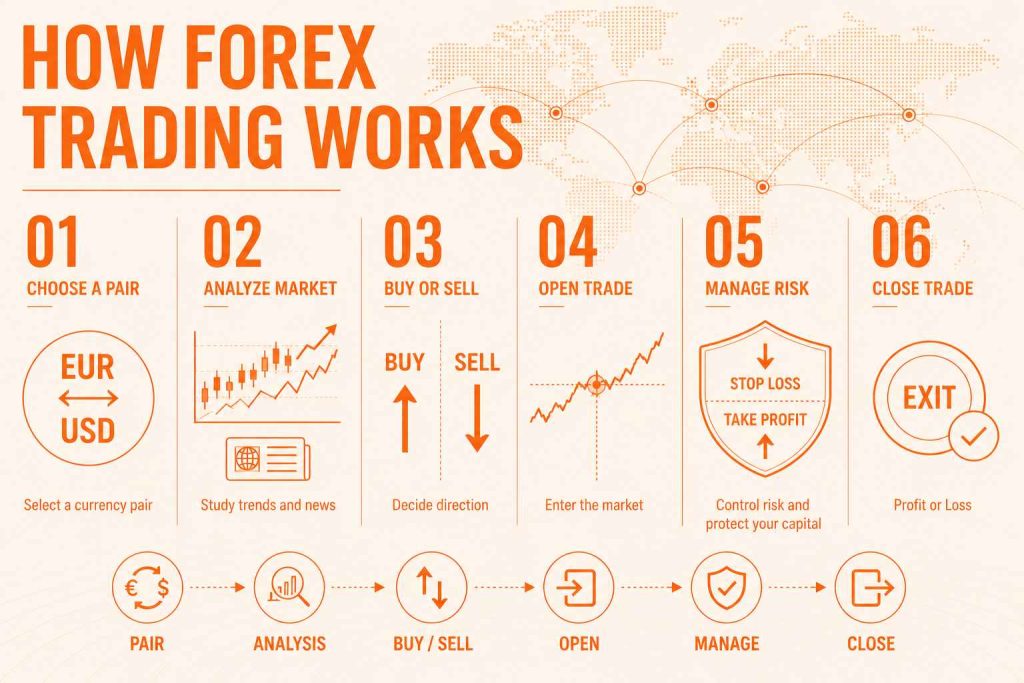
Now that you understand the idea behind the forex market, it helps to see how a trade actually unfolds in real life. On the surface, it may look like chaos, but in reality, the forex market’s step-by-step workings follow a clear sequence that every trader goes through, whether beginner or advanced.
Here is a simple breakdown of the process:
- Choose a currency pair. In forex trading, everything starts with selecting a pair like EUR/USD or GBP/JPY. You are always working with two currencies, where one is compared against the other.
- Analyze the market. Traders study news, trends, and price charts to form an idea of where the market might go. This step is about reading the “story” behind price movement.
- Decide to buy or sell. If you expect the first currency to rise, you buy. If you expect it to fall, you sell. This is the core decision in forex trading.
- Open the trade. You enter the market at a specific price level. From this moment, your trade is active and reacting to every small price movement.
- Manage the position. Traders often set stop-loss and take-profit levels to control risk and lock in potential gains. This is where discipline really matters.
- Close the trade. The position is closed either manually or automatically. The difference between entry and exit price becomes your profit or loss.
Key Concepts Every Beginner Should Know
Once you understand the basic flow of a trade, the next step in forex trading is getting familiar with the language of the market. At first, it can feel like learning a new dialect, but these concepts are the building blocks that separate guessing from informed decision-making. If the market is a game, these are the rules you need to know before you start playing.
Here are the most important concepts explained in simple terms:
Essential Forex Terms Every Beginner Should Know
Who Participates in the Forex Market?
When people first hear about the forex market, they usually picture individual traders staring at charts and trying to predict price moves. In reality, forex trading is much bigger than that. It is a layered global ecosystem where different participants operate with completely different goals, time horizons, and strategies. Think of it like a massive financial ocean where every group creates its own current, and together they shape the movement of the market.
What makes this structure interesting is that no single participant controls it. Instead, the forex market is driven by the interaction between powerful institutions and everyday traders, all reacting to the same economic signals but in very different ways.
Key Players in the Forex Market
Why People Trade Forex
At first glance, forex trading might look like a fast-moving, slightly chaotic world of charts and numbers. But behind that surface, there is a simple reason why millions of people get involved: opportunity. The forex market offers constant movement, deep liquidity, and the chance to take advantage of global economic shifts without needing to own any physical assets. For many traders, it feels less like “buying and holding” and more like surfing waves that never stop forming.
Another big attraction is accessibility. Unlike traditional financial markets, forex trading is open almost 24 hours a day, meaning you can participate after work, before work, or even in the middle of the night if you want. It is flexible, global, and reacts instantly to news, which makes it both exciting and challenging at the same time.
Forex Market Snapshot
Why the Forex Market Moves
If you strip everything down, the forex market is really just a constant battle between supply and demand. But what actually pushes currencies up and down is not random noise. In forex trading, price movement is driven by real-world events, expectations, and human psychology reacting at scale. Think of it like a living system that breathes in news and exhales volatility.
Traders often describe the market as a “reaction machine.” One piece of data can shift sentiment instantly, while larger trends build slowly over time. That is why understanding what moves the forex market is more important than trying to predict every single candle on a chart.
What Moves Currency Prices
Risks of Forex Trading
Even though forex trading can look exciting and full of opportunity, it is important to understand that the forex market is not a controlled or predictable environment. Prices move fast, often reacting to news, emotions, and global events in ways that can surprise even experienced traders.
One of the main risks comes from how quickly the market can move against a position. A trade that looks stable in one moment can shift within seconds. This is why forex trading requires more than just market knowledge, it demands discipline and the ability to accept uncertainty as part of the process.
Another major factor is leverage. While it allows traders to open larger positions with smaller capital, it also increases exposure to losses. In the forex market, this means both profits and losses can be amplified, which makes risk management absolutely essential.
Finally, emotional decision-making is one of the most underestimated risks. Many beginners enter forex trading expecting consistent results, but reacting emotionally to wins and losses often leads to poor timing and unnecessary trades.
How to Start Forex Trading (Step by Step)
Starting with forex trading is less about jumping into the market and more about building a structured foundation. Most beginners rush into live trading and treat it like a quick opportunity, but in reality, the process works much better when it is slow, methodical, and consistent. Think of it as learning to navigate a constantly moving financial ocean before trying to sail in rough waters.
The goal at this stage is not to make money immediately, but to understand how the forex market behaves, how orders are placed, and how risk feels in real conditions. Once this foundation is in place, everything else becomes significantly easier to manage.
Step-by-Step Guide to Start Forex Trading
Conclusion
Understanding forex trading is not about memorizing charts or chasing every price move in the market. It is about seeing the bigger picture, how global participants interact, what drives currency prices, and how decisions are made in real time across the world. Once you connect these pieces, the market starts to look less like chaos and more like a structured system of reactions.
For beginners, the key takeaway is simple: the forex market rewards patience, consistency, and discipline far more than speed or intuition. Traders who take time to learn the fundamentals, manage risk properly, and build a clear process are usually the ones who stay in the game long enough to improve.
FAQ
What is forex trading in simple terms?
Forex trading is the process of buying and selling currencies in the global forex market to profit from price changes.
Is the forex market open all the time?
The forex market operates 24 hours a day, five days a week, across different global trading sessions.
Do I need a lot of money to start forex trading?
No, many brokers allow you to start forex trading with a small deposit, depending on account type and leverage.
Can beginners succeed in forex trading?
Yes, but only with proper learning, practice, and risk management in the forex market.
What moves the forex market the most?
The forex market is mainly driven by interest rates, economic data, geopolitical events, and market sentiment.

