
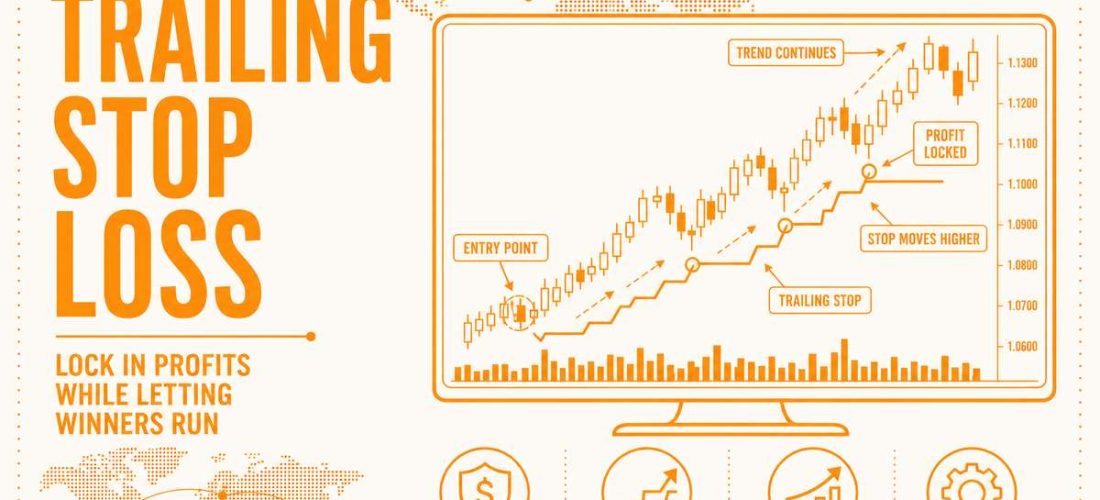
Trailing
Stop Loss
You finally picked a winner. The stock is climbing like a cat up a curtain. You are already spending the profits in your head. Then out of nowhere, the market pulls the rug. Your green trade bleeds red. Sound familiar?
That sinking feeling has a name: leaving money on the table. But there is a smarter way to lock in gains without staring at charts all day. You need to understand what is a trailing stop loss. Think of it as a fence that moves with your trade, locking in profits while letting the winner run. In this trailing stop loss explained for beginners guide, we will break down how this tool works, why it beats a regular stop loss, and how you can set it up in minutes. No PhD in finance required.
Trailing Stop Loss Definition
Let's keep this simple. A trailing stop loss definition sounds fancy, but the idea is as easy as tying your shoes.
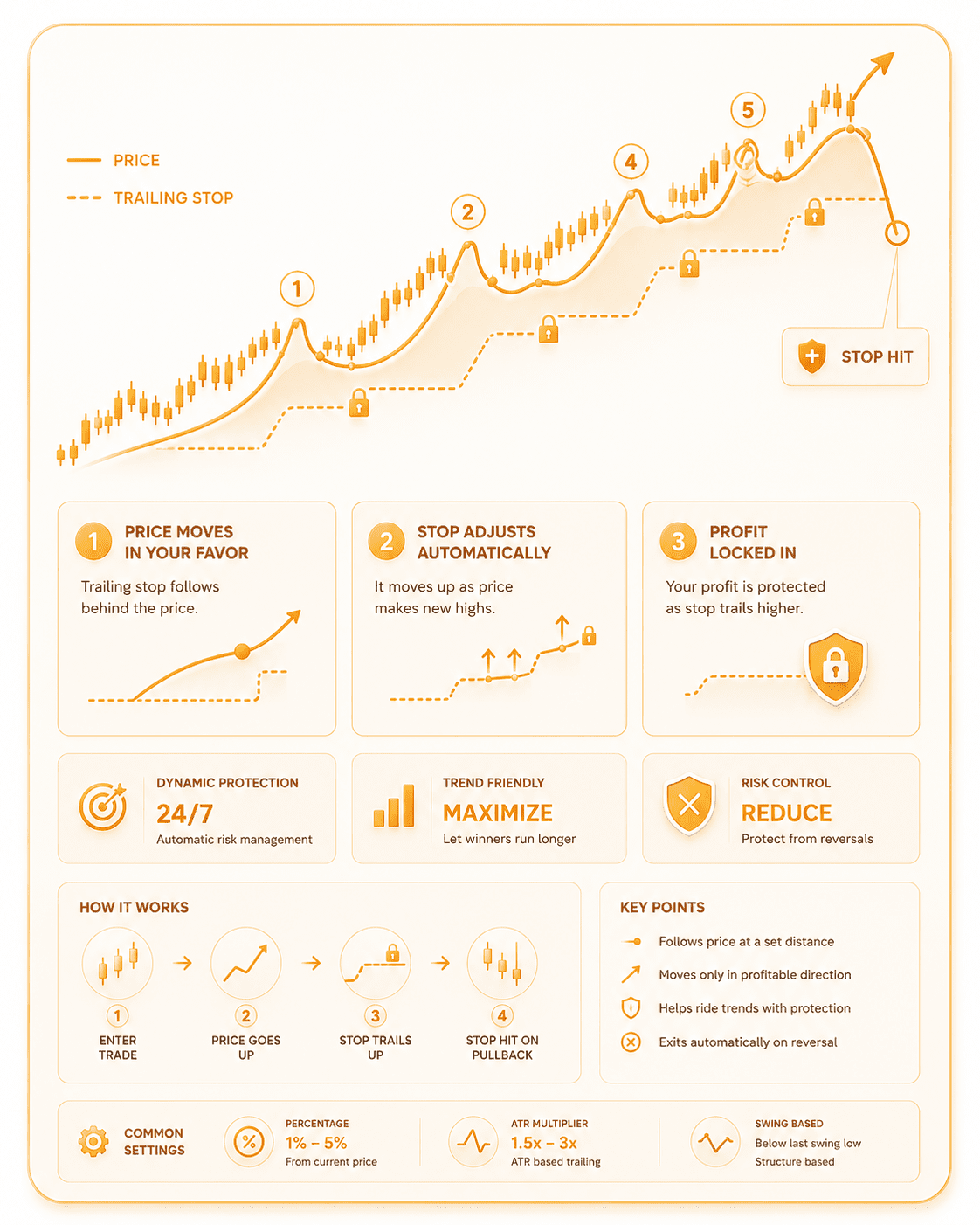
A trailing stop loss is an order that moves with your trade. When the price goes up, your stop goes up too. It follows like a shadow. When the price drops, the stop freezes. It never, ever moves down.
Here is the trailing stop loss meaning in plain English: You tell your broker, "Protect my profit, but let the trade breathe." Then the broker does the heavy lifting. If you are holding a long position (betting the price will rise), the trailing stop only creeps upward. It never steps backward. That means your downside protection gets tighter as you make more money, but you never lose the gains you already locked in.
Think of it like a GPS that recalculates your exit door every time the stock hits a new high. Pretty neat, right?
How Does a Trailing Stop Loss Work?
Let me walk you through it with a story.
You buy one share of a hot company at $100. You want to protect your backside, but you also want to ride the wave if this thing takes off. So you attach a trailing stop with a 5% trail.
Now here is the magic. How does a trailing stop loss work? Simple. The stop stays 5% below the highest price the stock has hit since you bought it.
The stock climbs to 110. Your stop jumps to 104.50 (that is 110 minus 5%). It climbs to 120. Your stop jumps to 114. It climbs to 130. Your stop jumps to 123.50.
The stop is like a dog on a leash. The dog follows you everywhere you go. But the leash never gets longer. It only gets tighter behind you.
Then the music stops. The stock peaks at 130 and starts to fall. It drops to 123.50. Bam. Your trailing stop triggers. You are out. You just locked in a 23.50 profit while everyone else who forgot their stop is watching their gains evaporate.
That is trailing stop loss how it works in a nutshell. You set the trail. The price runs. The stop chases it. The moment the price turns around and falls by your trail amount, the system hits the eject button.
So how trailing stop loss works boils down to three steps:
- You pick a trail amount (percentage or dollars).
- The stop follows the price up but never down.
- A drop of that size from the peak sells you out automatically.
No emotions. No second guessing. No watching the screen at 2 AM.
Trailing Stop Loss Example
Nothing beats a real life story. Numbers on a screen can feel abstract. But watching dollars move step by step? That is where the light bulb turns on.
Let me give you a trailing stop loss example that is so simple you will wonder why you are not using this already.
Imagine you buy one share of a company called CoolTech at $100. You are feeling good, but you are not crazy. You want to protect your downside while leaving the door open for a moonshot.
You attach a trailing stop loss with a 5% trail.
Here is exactly what happens next, step by step.
Step 1: The Buy
You enter at 100. Your trailing stop is 5% below at 95. If the stock tanks immediately, you are out with just a $5 loss. No drama.
Step 2: The Climb
CoolTech starts heating up. The price rises to 110. Your trailing stop wakes up and follows. It recalculates. 5% below 110 is 104.50. Your stop just moved up by 9.50 automatically. You did not lift a finger.
Step 3: Higher Still
The stock keeps running. It hits 120. Your trailing stop chases it like a shadow. 5% below 120 is 114. Your stop is now 114. You have already locked in a $14 profit even if the market turns south right this second.
Step 4: The Peak
CoolTech touches 120 and runs out of gas. It starts to drift lower. Your stop stays at 114. It never moves down. It just waits.
Step 5: The Trigger
The price falls to 114. Bam. Your trailing stop loss order triggers. You are out of the trade automatically. You walk away with a $14 profit.
Now here is the kicker. Without a trailing stop, you might have watched CoolTech fall all the way back to $100 or lower. You would have given back every penny. But because you used this trailing stop loss with example, you kept your money and slept like a baby.
That is the power of letting technology watch the market for you.
Stop Loss vs Trailing Stop Loss
Smart traders use both — one for safety, one for profit protection.
Let me ask you something. Would you rather wear a belt that never moves or a belt that tightens automatically as you lose weight? Both hold your pants up. But one is a lot smarter.
Trading is the same. You have two main tools to protect your money. One is old school. The other is a upgrade. Let me break down stop loss vs trailing stop loss so you never confuse them again.
The Regular Stop Loss: Your Static Safety Net
A regular stop loss is simple. You pick a price. You stick it there. It does not move. Ever.
A fixed stop is great for one job: limiting how much you can lose right out of the gate. But it is terrible at protecting profits once the trade takes off.
The Trailing Stop Loss: Your Moving Shield
Now let me show you trailing stop loss vs stop loss side by side.
A trailing stop loss does not sit still. It follows the price up. It only moves in one direction. Up. When the stock climbs, your stop climbs right behind it. When the stock turns around, your stop freezes and waits to pull you out.
The Bottom Line
Here is the truth. Stop loss vs trailing stop loss is not really a fight. They are tools for different jobs.
Use a regular stop loss when you first enter a trade. It keeps you from bleeding out if you are wrong.
Use a trailing stop loss vs stop loss when you are already in profit. That is when the trailing stop shines. It lets your winner run while locking in gains behind the scenes.
Think of it this way. A regular stop loss is a fire extinguisher. You hope you never need it. A trailing stop loss is a rising floor. The higher you go, the higher it lifts you so you never fall too far.
One saves you from disaster. The other turns good trades into great ones.
How to Set Trailing Stop Loss
I am going to let you in on a secret. Setting a trailing stop loss is easier than ordering a coffee on an app. Seriously. If you can tap three buttons, you can do this.
Let me walk you through it step by step. No fancy jargon. No confusing menus. Just meat and potatoes.
Step 1: Open Your Order Entry Window
You have found a trade you like. You are ready to pull the trigger. Before you click that buy or sell button, look around the order form. Somewhere on that screen, usually under a dropdown menu that says "Order Type" or "Stop Loss," you will find the golden ticket.
Step 2: Select "Trailing Stop Loss"
This is where the magic lives. Instead of picking a regular stop loss or a simple limit order, you choose trailing stop loss order from the list. On some platforms, it might say "Trailing Stop" or "Trailing Stop %." Same thing. Different shirt.
Step 3: Choose Your Trail Type
Now you have a decision to make. Pepperoni or cheese? Actually, it is percentage or points.
- Percentage means the trail moves with the price by a percent. Example: 5% trail.
- Points (sometimes called dollars or ticks) means a fixed dollar amount. Example: $2.50 trail.
If you are new, start with percentage. It is more forgiving and adjusts automatically to the price.
Step 4: Enter Your Trail Amount
This is where how to set trailing stop loss gets real. Pick a number that gives your trade room to breathe but still protects your backside.
For a volatile stock, go wider. Say 10% to 15%.
For a calm stock, go tighter. Say 3% to 5%.
Do not guess. Look at the stock's average daily wiggle. If it moves 4% every single day, do not set a 2% trail. You will get thrown out before breakfast.
Step 5: Confirm and Walk Away
Hit that submit button. Your trailing stop loss order is now live. The broker will do the heavy lifting. You can close your laptop. Walk your dog. Make a sandwich. The stop follows the price up automatically and waits to pull the trigger if things go south.
Now here is the best part about how to use trailing stop loss once it is set. You do nothing. Literally nothing. No adjusting. No watching. No panic selling. The machine works for you.
A Quick Word of Caution
Not every broker offers trailing stops on every asset. Stocks? Almost always. Crypto? Sometimes. Forex? Usually yes. Options? Rarely. Check your platform's order types before you fall in love with the idea.
Also, some brokers call it a "trailing stop limit order" instead of a market order. That is a slightly different animal. For beginners, stick with a regular trailing stop loss order that triggers a market sell. It is cleaner and faster.
How to Use Trailing Stop Loss
Knowing how to turn on a tool is one thing. Knowing when to use it? That is the secret sauce.
A trailing stop loss is like a chainsaw. In the right hands, it is a beast. In the wrong hands, you might cut your own leg off. Let me show you exactly how to use trailing stop loss like a pro, when to pull it out of the toolbox, and whether you should even bother at all.
When to Use Trailing Stop Loss (Timing Is Everything)
Here is the number one mistake beginners make. They slap a trailing stop on a trade the second they buy it. That is like putting on a raincoat before you even step outside. Sure, you are protected. But you might also miss the sunshine.
So when to use trailing stop loss? Only after you are in profit. Let me explain.
You buy a stock at $100. It is flat. It is boring. It goes nowhere. A trailing stop does nothing for you here because the price is not moving up. Save it for later.
But then the stock climbs to 105. Now you have a $5 cushion. This is the moment. You attach your trailing stop. Why? Because you have turned a trade into a free roll. The worst case now is you get out with a small profit instead of a loss.
Think of it like this. You do not put training wheels on a bike that is still in the garage. You put them on once you start moving.
Where to Use It
How to use trailing stop loss successfully depends on the market personality.
- Trending markets are your best friend. A stock that climbs higher and higher every day? Perfect. The trailing stop follows it up like a loyal puppy.
- Choppy ranges are your enemy. A stock that bounces up and down like a ping pong ball will trigger your stop again and again. You will get whipsawed into a dozen small losses. That is death by a thousand cuts.
So read the room. Is the market making higher highs? Go ahead. Is it going nowhere fast? Keep your trailing stop in your pocket.
Should I Use Trailing Stop Loss? The Honest Answer
Let me answer the question every beginner asks. Should I use trailing stop loss?
Yes. But only if you cannot watch the screens all day.
Here is the truth. If you are glued to your charts from 9:30 to 4:00, you might not need a trailing stop. You can use your eyeballs and your brain. You can make decisions in real time.
But if you have a job. Or kids. Or a life. You cannot stare at candles all day. That is where the trailing stop becomes your best employee. It works while you sleep. It watches while you eat dinner. It sells while you are stuck in traffic.
For most people, the answer is a loud yes.
One More Thing: Let Your Winners Breathe
The biggest mistake I see with how to use trailing stop loss is setting the trail too tight. People get scared. They set a 1% trail on a stock that moves 3% every day. Then they wonder why they get thrown out before the big rally.
Give your trade some room. A tight leash chokes a runner. A loose leash lets it run.
Trailing Stop Loss Strategy
Let me tell you something that took me years to learn. A tool is only as good as the strategy behind it.
You can own the sharpest knife in the kitchen. But if you do not know how to slice, you are still going to mash the tomato. Same goes for trailing stops. You need a game plan.
Let me share some battle tested trailing stop loss strategy ideas that actually work.
The ATR Trick (This One Is Gold)
Most people guess their trail amount. They throw a dart and hope for the best. That is not a strategy. That is gambling.
The pros use something called ATR, or Average True Range. Fancy name. Simple idea. ATR tells you how much a stock normally wiggles in a single day.
Here is the move. Set your trail to two or three times the ATR.
Example: A stock has an ATR of 2. That means it usually moves up or down about two bucks a day. Set your trailing stop at 2 to 3× ATR — around $4 to $6. That gives the stock room to breathe without triggering your stop on every little burp.
This is not magic. It is math. And it works.
Long Term vs Swing Trading
Not all trades are created equal. A position you plan to hold for six months needs a different leash than a trade you want to flip in six days.
For the slow and steady crowd, use a wide trail. Think 10% to 15%. Why? Because long term investments have deep pullbacks. If your trail is too tight, you will get shaken out during a normal dip and miss the next leg up.
For the quick flip crowd, use a tighter trail. Think 3% to 5%. Swing traders are not looking for home runs. They want base hits. A tighter lock keeps your profits safe without giving back too much.
So here is the best trailing stop loss strategy boiled down to one sentence. Match your trail to your timeline. Wide for the marathon. Tight for the sprint.
Is Trailing Stop Loss Good or Bad? Let Me Be Straight With You
You will hear people argue about this like it is politics. One side says trailing stops are a gift from the trading gods. The other side says they are a ticket to getting stopped out again and again.
Who is right? Both of them. Depends on the market.
Trailing stop loss good or bad breaks down to one question. What is the market doing?
- Good in trending markets. When stocks are climbing stairs to the moon, a trailing stop is your best friend. It follows the uptrend and locks in profits like a bank vault.
- Bad in sideways markets. When the price is bouncing between the same two numbers like a bored kangaroo, a trailing stop will eat you alive. You buy. It bounces up. Your stop trails. Then it bounces down. You get stopped out for a tiny loss. Then it bounces up again without you. Rinse and repeat. Death by a thousand paper cuts.
So before you slap a trailing stop on every trade, look at the chart. Are you in a nice clean uptrend with higher highs and higher lows? Go for it. Are you in a messy range with no direction? Keep your cash on the sidelines or use a different tool.
The Bottom Line on Strategy
A trailing stop loss strategy is not set it and forget it. You have to match the tool to the market. Wide for the long haul. Tight for the quick flip. Use ATR to stop guessing. And never, ever use a trailing stop in a chop fest unless you enjoy pain.
Do that, and you will turn a good tool into a great one.
What is a Good Trailing Stop Loss Percentage?
This is the question I get more than any other. People want a magic number. A one size fits all answer they can tattoo on their wrist.
I wish it were that simple. But the truth is a little messier. Let me walk you through the numbers so you can stop guessing and start knowing.
The Short Answer
If you are standing in the grocery store aisle and need an answer right now, here it is. A 5% to 8% trailing stop works for most people most of the time.
But you did not come here for the short answer. You came here to actually understand. So let me break it down by time frame.
Day Trading: 2% to 5%
Day traders are in and out before lunch. They do not care about next week. They care about the next twenty minutes.
For these folks, what is a good trailing stop loss percentage? Tight. Really tight. Two to five percent.
Why so tight? Because day traders chase small moves. A 10% trail would be pointless when the stock only moves 3% all day. You would never get stopped out, but you would also never lock in profits. Your trailing stop would just sit there like a lazy security guard.
Two to five percent gives day traders room to breathe without leaving the building.
Swing Trading: 5% to 10%
Swing traders hold for days or weeks. They catch medium sized waves. Not the tiny ripples of a day trader. Not the ocean currents of a long term investor.
For swing traders, the best trailing stop loss percentage usually lands between 5% and 10%.
Here is why. A swing trade needs to survive the nightly news, the morning gap, and the occasional bad tweet. A 3% trail is too tight for that. You will get thrown out on a normal Tuesday pullback. But a 15% trail is too loose. You will give back all your hard earned gains.
Five to ten percent is the sweet spot. Tight enough to protect. Loose enough to survive.
Long Term Investing: 10% to 20%
Long term investors are playing a different game. They buy and hold for months or years. They do not care about daily noise. They care about major trends.
For these patient souls, what is the best trailing stop loss percentage? Wide. Ten to twenty percent.
Think about it. The stock market drops 10% every couple of years just for fun. If you have a 5% trail, you will get stopped out during a normal correction and miss the next bull run. That is a disaster.
A 10% to 20% trail lets you ride out the storms while still protecting you from a real crash. It is the difference between an umbrella and a bunker.
So What Is the Ideal Trailing Stop Loss Percentage?
Let me give you a table to steal.
| Time Frame | Typical Range | Sweet Spot |
|---|---|---|
| Day Trading | 2% to 5% | 3% |
| Swing Trading | 5% to 10% | 7% |
| Long Term | 10% to 20% | 15% |
For most retail traders sitting at home, the ideal trailing stop loss percentage lives in the 5% to 8% zone. That covers swing traders and position traders who hold for weeks or months.
But Here Is the Catch
The recommended trailing stop loss percentage depends on one thing more than anything else. Volatility.
A stock that moves 1% a day can handle a 3% trail. A crypto that moves 10% a day needs a 15% trail or you will be stopped out before breakfast.
Do not just copy someone else's number. Look at the chart. See how much the price jumps around on a normal day. Set your trail above that noise. Otherwise you are just donating your money to the market makers.
One Last Thought
The typical trailing stop loss percentage you hear on YouTube might work for that trader's stocks. But your stocks are different. Your time frame is different. Your stomach for risk is different.
Use the ranges I gave you as a starting line, not a finish line. Then adjust up or down based on how much the asset moves and how much sleep you want to lose.
A good trailing stop is not a magic spell. It is a dial you can turn. Start at 7%. If you get stopped out too early, turn it wider. If you are giving back too much profit, turn it tighter.
That is how the pros do it.
Trailing Stop Loss Percentage / Points / Dollar Amount
Not all trails are created equal. Some are stretchy. Some are stiff. Some measure in percentages. Some measure in raw dollars.
Let me break down the three main ways to set your trail so you can pick the right one for the job.
Trailing Stop Loss Percentage: The Stretchy Leash
A trailing stop loss percentage moves with the price like a rubber band. If the stock is 100 and you set a 5% trailing stop, the stop sits at 95. If the stock climbs to 200, your stop climbs to 190. The percentage stays the same. The dollar gap grows.
This is the most popular choice for a reason. It is automatic. It scales. You do not have to think about it.
When to use it? Almost always. Percentage trails handle volatility gracefully. A 5% move on a 100 stock is meaningful. A 5% move on a 200 stock is just a Tuesday. Percentage trails adjust for you.
Trailing Stop Loss Points: The Fixed Dollar Leash
A trailing stop loss points trail (sometimes called dollars or ticks) is a fixed number. You set it at 5. It stays at 5 forever. The stock could be 100 or 1000. Your trail is still $5.
This is a straight jacket. It does not stretch. It does not bend.
When to use it? When you are trading something with a very stable price range. Think ETFs, blue chip stocks, or futures contracts with known tick sizes.
The downside is obvious. A $5 trail on a 100 stock is a tight 5%. A $5 trail on a 1000 stock is a razor-thin 0.5%. You will get stopped out by a stray breeze.
Trailing Stop Loss Dollar Amount: Best for Wide Price Instruments
Here is where things get interesting. The trailing stop loss dollar amount shines when you are trading instruments with very different price levels.
Think about trading Apple at 200 versus a penny stock at 2. A 5% trail on Apple is $10. A 5% trail on the penny stock is 10 cents. Both work, but if you try to use a fixed dollar trail across both, you are in trouble.
For wide price instruments, a trailing stop loss dollar amount lets you set a meaningful number that is not tied to percentages. You might decide you want to risk exactly $500 per trade. A dollar-based trail makes that easy to calculate.
Professional traders often use dollar trails when they are sizing positions carefully. It gives them precise control over risk.
How to Match Your Trail Amount to Volatility
Here is the golden rule. Match trailing stop loss trail amount to volatility.
Volatility is just a fancy word for how much the price bounces around. A calm stock like Coca Cola moves 1% on a wild day. A crazy stock like a biotech startup moves 10% before lunch.
If you use a 2% trail on that biotech stock, you will be stopped out in fifteen minutes. Every single time. You are setting money on fire.
If you use a 15% trail on Coca Cola, your stop might as well not exist. The stock will never hit it. You will ride a small gain all the way down to a loss because your leash was too long.
So how do you find the sweet spot? Look at the Average True Range I mentioned earlier. If the stock normally moves 2 a day, set your trail at 4 to 6. Double or triple the normal wiggle. That gives the stock room to breathe without letting it run away from you.
Which One Should You Pick?
Here is my honest advice for beginners. Start with trailing stop loss percentage. Set it between 5% and 8%. It is forgiving. It scales. It is hard to mess up.
Once you get comfortable, experiment with trailing stop loss points or dollar amounts on assets you know well. You might find they give you finer control.
But do not overcomplicate it. A percentage trail done poorly is better than a dollar trail done perfectly but never set because you were confused.
Keep it simple. Keep it moving. And always match your trail to the volatility of whatever you are trading.
Trailing Stop Loss and Take Profit
Can you use trailing stop loss and take profit on the same trade? The short answer is no. They do not play nice together.
A trailing stop replaces your fixed stop. It is like having two drivers behind the same wheel. Most brokers make you pick one.
But Here Is the Workaround
Set your take profit order first. Buy at 100, take profit at 120. That is your exit if the stock shoots straight up.
Then set a trailing stop loss below that price. Say at 115. If the stock pushes past 120, your take profit triggers and you are done. Happy day.
If the stock stalls at $118 and rolls over, your trailing stop catches it on the way down. You still lock in a profit.
So you are not using both at the same time. You are using one as a backup for the other. Think of it like a seatbelt and an airbag. Different tools. Same goal. Keeping you safe.
Trailing Stop Loss Automatic
Here is the best part about this whole setup. Once you turn it on, you can walk away.
Trailing stop loss automatic means the broker does all the heavy lifting. You do not have to wake up at 2 AM to adjust your stop. You do not have to stare at candles for six hours. The computer watches the price. The computer moves the stop. The computer pulls the trigger when it is time.
That is the beauty of automatic trailing stop loss. Set it once. Forget it. Let the machine work while you sleep, eat, or walk your dog.
No emotions. No second guessing. No panic selling because you got scared. Just cold, hard automation that locks in profits without you lifting a finger.
Trailing Stop Loss for Long Term Investment & Swing Trading
Not every trade wears the same size shoes. Your trailing stop should match your timeline.
Trailing stop loss for long term investment means playing the marathon, not the sprint. You hold for months or years. The market will throw punches. There will be 10% dips that make you sweat. If your trail is too tight, you will get thrown out during a normal correction and miss the next leg up. Go wide. Fifteen to twenty percent. That is your zone.
Trailing stop loss for swing trading is a different animal. You hold for days or weeks. You are catching medium waves, not ocean currents. You cannot afford a 20% trail because you do not have that kind of room. Go tighter. Four to seven percent. Tight enough to protect. Loose enough to let the trade breathe.
Long term = wide. Swing trading = tight. Do not mix them up.
Trailing Stop Loss with ATR
Guessing your trail amount is a rookie move. The pros use a tool called ATR, or Average True Range. Fancy name. Simple idea.
ATR tells you how much a stock normally wiggles in a single day. If the ATR is $2, the stock usually moves up or down about two bucks. So what should your trail be? Double it. Or triple it.
Trailing stop loss with ATR is dead simple. Set your trail to two or three times the ATR. ATR is 2? Set your trail at 4 or 6. ATR is 5? Set your trail at 10 to 15.
This is not magic. It is math. And it works because your stop now matches the market's natural noise. Too tight and you get stopped out on every burp. Too loose and you give back all your gains. Two to three times ATR is the sweet spot.
Let the stock wiggle. Just do not let it run away.
Types of Trailing Stop Loss
Not every trailing stop is built the same. You have options. Let me walk you through the menu.
Percentage based is the most popular. You set a number like 5%. The stop stays 5% below the highest price. Simple. Effective. Hard to mess up.
Point or dollar based is a fixed number. You set a 5 trail. It stays 5 forever. The stock could be 100 or 1000. Your trail does not care. Great for stable stocks. Terrible for wide price swings.
ATR based is the pro move. You set your trail to two or three times the Average True Range. This automatically adjusts to how much the stock normally wiggles. Volatile stock gets a wider trail. Calm stock gets a tighter trail. Smart.
Then there is a special one called trailing stop loss based on last. Most trailing stops use the intraday high. The highest price the stock touched during the day. That sounds good, but it has a flaw. One five second spike can trigger your stop even if the stock closed flat.
Trailing stop loss based on last fixes that. It uses the last close price instead of the intraday high. Less sensitive to spikes. Fewer fake outs. Better for swing traders who hate getting whipsawed.
Pick the type that fits your personality and your market.
Does Trailing Stop Loss Work? (Pros and Cons)
Let me give it to you straight. Does trailing stop loss work? Yes. But only in the right conditions.
In a trending market where prices climb like stairs to the moon? Works like a charm. In a sideways chop fest where prices bounce like a ping pong ball? It will eat your lunch.
Here are the trailing stop loss pros and cons.
Pros: Fully automated. You set it and forget it. Locks in profits without you lifting a finger. No emotions. No panic selling. No second guessing. Your greedy brain cannot talk you out of a good exit.
Cons: Premature exits in volatile markets. A sudden spike down can trigger your stop even if the trend is still up. You get thrown out right before the rocket takes off. That stings.
So is trailing stop loss good? Often yes, especially with wide trails. Give the trade room to breathe. Do not choke it with a tight leash. A wide trail lets you survive the noise and catch the big moves.
Like any tool, it is not magic. But in the right hands, it is a weapon.
CONCLUSION
Here is the bottom line. This trailing stop loss guide proves one thing. The trailing stop loss feature is not just a fancy button on your broker's app. It is one of the most practical tools in your entire toolbox.
You do not need to be a Wall Street pro to use it. You do not need a PhD in finance. You just need to understand the basics. Pick your trail type. Match it to your timeline. Give the trade room to breathe. Then walk away.
Master this one feature, and you will stop watching your winning trades turn into losers. You will stop leaving money on the table. You will protect profits automatically, even while you sleep.
And is not that the whole point? Making money is great. Keeping it is better.
FAQ
What is a trailing stop loss?
A trailing stop loss is an order that follows price movement to lock in profits.
How does a trailing stop loss work?
It moves your stop upward as price rises. When price falls by the trail amount from its peak, the stop triggers.
What is a good trailing stop loss percentage?
5% to 8% is typical. Long term: 10% to 20%. Day trading: 2% to 5%.
What is the best trailing stop loss percentage?
There is no universal best. Use ATR to find volatility adjusted percentages.
What is a trailing stop loss order?
A conditional order that combines a stop price with a trailing amount.
Stop loss vs trailing stop loss — which is better?
Stop loss for entry protection. Trailing stop loss for profit protection.
When to use trailing stop loss?
After a trade is in profit, especially in trending markets.
Does trailing stop loss work?
Yes, in trending markets. No, in sideways chop.
Should I use trailing stop loss?
Yes, to automate exits and manage emotions.
Why is trailing stop loss good or bad?
Good because it locks profits. Bad because it can exit early in volatile conditions.
How to set trailing stop loss?
Right click your position, select Trailing Stop, then choose points or percentage.
What is trailing stop loss meaning in simple words?
A stop that chases price up but never down.
What is the ideal trailing stop loss percentage for swing trading?
5% to 7% is common.
Can I use trailing stop loss and take profit together?
Not directly. But you can add a profit target separately.
What is trailing stop loss based on last?
A trail based on last close price instead of intraday high. It reduces noise and fake outs.


