
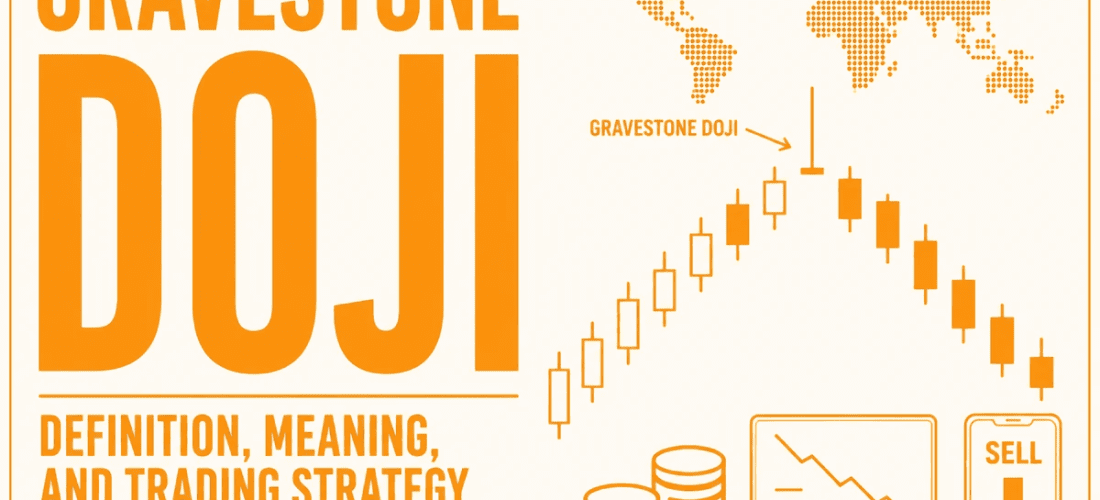
Gravestone
Doji
A gravestone doji looks exactly like its name. A long vertical line with a thin horizontal line at the bottom. It forms when the price shoots up during the session but closes right where it opened. Buyers tried. Sellers pushed back. Nobody won.
In this article, I’ll explain the gravestone doji definition, what it means in plain English, how to spot this candlestick pattern on any chart, and a simple way to trade it. No fluff. Just the setup I actually use.
What Is a Gravestone Doji?

Let me answer that with a simple picture in your head. Take a candlestick. The open, close, and low are all at the exact same price. The height is way up there with a long upper wick. That’s it. That’s what a gravestone doji is in a nutshell.
Visually, it looks like a tombstone. The body is tiny or nonexistent. The upper shadow is long. The lower shadow is zero. This tells me one thing. Buyers pushed the price up hard, but by the end of the session, sellers dragged it back to square one. Neither side won the war.
How is it different from other dojis? A dragonfly doji has a long lower wick and no upper wick. A long-legged doji has both wicks long. The gravestone is the opposite of a dragonfly. It’s the rejection candle. Price tried to go up. Got rejected. End of story.
Gravestone Doji Meaning
Here’s the real gravestone doji meaning. It’s all about failure. Buyers woke up optimistic. They pushed the price higher, sometimes much higher. But by the time the session ended, sellers stepped in and pushed the price back down to where it started.
Think of it like a boxing match. The buyer throws a huge punch, almost wins, but the seller counters at the last second and the round ends in a draw. Nobody lands the knockout. That’s the psychology here. The market tried to go up. It failed. Higher prices got rejected. Plain and simple.
3. Gravestone Doji Candlestick vs. Other Candles
A gravestone doji candlestick is easy to spot once you know what to look for. Long upper wick. No lower wick. Open, close, and low all match. But how do I tell it apart from its cousins?
The dragonfly doji is the mirror image. Long lower wick, no upper wick. That’s the opposite. The long-legged doji has both wicks long, like a plus sign. That one means total confusion.
Why is the gravestone doji candlestick pattern considered a reversal signal? Because it shows exhaustion. After a nice uptrend, this candle tells me buyers ran out of gas. Sellers took back control. One candle. That’s all it takes to hint at a turn.
Gravestone Doji Candle in Uptrends and Downtrends
A gravestone doji candle behaves differently depending on where it shows up. Context is everything.
In an uptrend, this is a bearish reversal signal. Price has been climbing. Then this tombstone appears. Buyers tried to push higher but failed. Sellers are waking up. I take it seriously.
Now let’s talk about a gravestone doji during a downtrend. This one is trickier. Price is already falling. This candle shows up. Does it mean a reversal? Not so fast. In a downtrend, it can signal exhaustion, but it needs confirmation. One candle isn’t enough. I wait for the next bar to close green before I even think about buying.
Can a Gravestone Doji Be Bullish?
Yes, but don’t get too excited. A bullish gravestone doji is rare. Here’s when it happens.
You’re in a strong downtrend. Sellers are in control. Then a gravestone doji appears. Wait, isn’t that a bearish candle? Normally yes. But after a long drop, this candle shows that sellers tried to push the price lower and failed. The long upper wick means buyers actually stepped in and pushed the price up, even if it closed near the open.
The catch? You need a green confirmation candle the next day. Without it, the bullish gravestone doji is just a mirage. With it, you might have a trend reversal to the upside.
Opposite of Gravestone Doji
The opposite of a gravestone doji is the dragonfly doji. Simple as that. Here’s the comparison:
| Feature | Gravestone Doji | Dragonfly Doji |
|---|---|---|
| Long wick | Upper | Lower |
| Missing wick | Lower | Upper |
| What it rejects | Higher prices | Lower prices |
| Signal in uptrend | Bearish reversal | Bullish continuation (rarely reversal) |
Gravestone says rejection of highs. Dragonfly says rejection of lows. Two sides of the same coin.
Trading Strategy with Confirmation
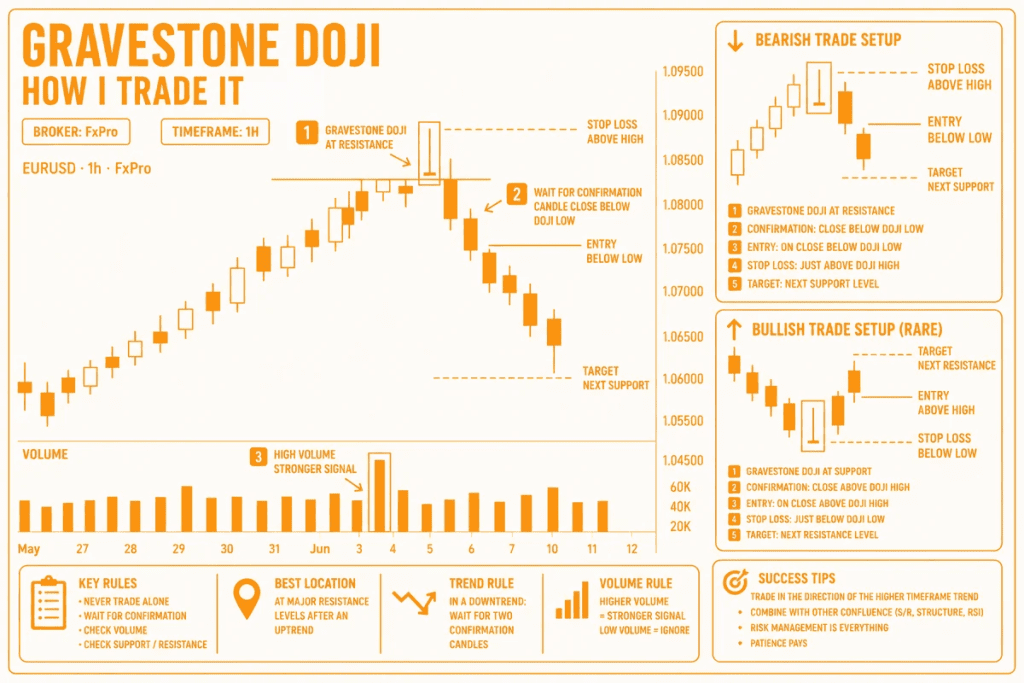
Here’s how I actually trade this pattern. No guessing.
First, I never trust a gravestone doji alone. I wait for confirmation. That means the next candle closes below the doji’s low for a bearish trade, or above its high for a bullish trade.
Second, I check the volume. Higher volume on the doji makes the signal stronger. Low volume? I ignore it.
Third, I look at support and resistance. A gravestone doji at a major resistance level is gold. At random places in the middle of nowhere, it’s noise.
For a bearish trade: entry on the close below the doji low. Stop loss just above the doji high. Target the next support level.
For a bullish trade (the rare one): entry on the close above the doji high. Stop loss just below the doji low. Target the next resistance.
One more rule. If the doji appears during a downtrend, I need two confirmation candles, not one. Patience pays.
Conclusion
The gravestone doji candlestick pattern is one of my favorite tools for spotting exhaustion. Whether you see a classic gravestone doji candle at a resistance level or a rare bullish gravestone doji after a sharp decline, one rule never changes. Wait for confirmation.
Understanding the opposite of the gravestone doji, the dragonfly, helps you see the full picture. One rejects highs. The other rejects lows. Add this pattern to your analysis, combine it with volume and trend context, and you will make higher probability trades. No single candle is a crystal ball. But this one? It talks.
FAQ
What is a gravestone doji in simple terms?
A gravestone doji is a candle with the same open, close, and low price, and a long upper wick. It shows price went up but closed near the low.
Is a gravestone doji always bearish?
Generally, yes, in an uptrend. But a bullish gravestone doji can occur in a downtrend if followed by strong buying.
What is the opposite of gravestone doji?
The opposite of a gravestone doji is a dragonfly doji. It has a long lower wick and rejects lower prices.
How to trade a gravestone doji during downtrend?
A gravestone doji during a downtrend suggests selling pressure may be pausing. Wait for a bullish confirmation candle before entering long.
Can beginners use the gravestone doji candlestick pattern?
Yes. The gravestone doji candlestick pattern is easy to spot and works well with support and resistance levels and trend analysis.

