
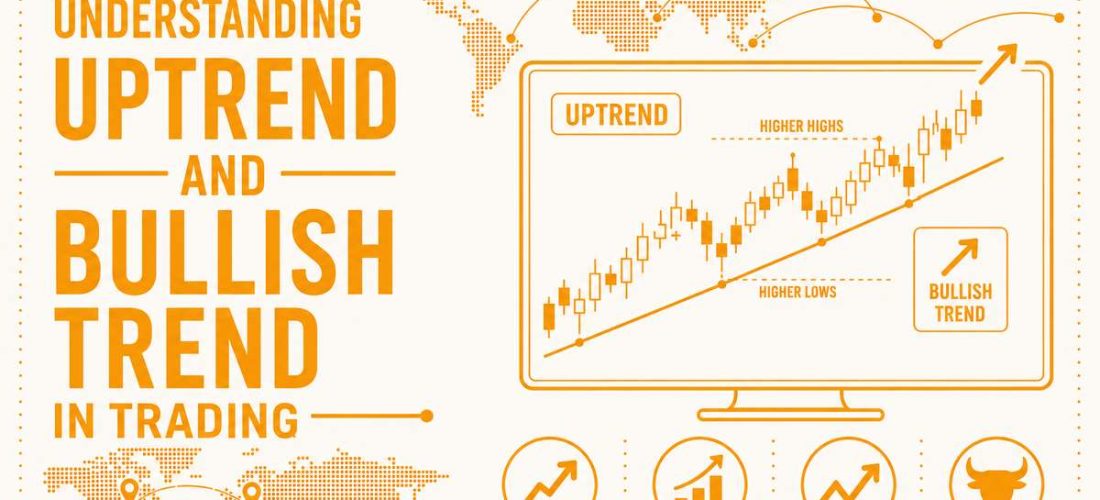
Understanding Uptrend and Bullish Trend
Look, let me cut to the chase. An uptrend is like a rising tide that lifts all boats except in trading, it lifts your confidence and your account balance if you play it right. Most beginners lose money because they fight the market instead of trying to undestand what’s going on. Don’t be that guy.
Picture this: you’re at a concert, and everyone’s moving toward the stage. Fighting the crowd is dumb. Going with the flow? That’s smart money. Same thing in trading. When an uptrend gets rolling, it’s not magic it’s momentum, plain and simple. And once you learn to spot it early, you stop guessing and start riding.
What Is an Uptrend in Trading?

Let me break this down so it actually sticks. An uptrend is simply when price keeps making higher highs and higher lows. That’s it. Think of it like climbing a staircase, every step up is a new high, and every small pullback stays above the last low. That’s an uptrend doing its thing.
Now, here’s where beginners get tripped up. They see a green candle and yell “uptrend!” like it’s a winning lottery ticket. But that’s not how it works. An uptrend isn’t one lucky bar on a chart it’s a whole vibe. It’s the market telling you, “hey, buyers are in charge.” And when buyers run the show, your job isn’t to guess the top. Your job is to hop on and enjoy the ride until the music stops.
So every time you look at a chart, ask yourself one question: are we making higher highs and higher lows? If yes, congrats! An uptrend is alive and kicking. If not, put your hands in your pockets and wait. No shame in standing still while the market figures itself out.
What Does a Bullish Trend Mean? (And Why the Bull?)
First, let’s talk about the animal.
Why a bull? Why not a lion, a shark, or a really aggressive squirrel?
Here’s the classic answer. A bull attacks by swinging its horns upward. Throws its enemy into the air. So when prices are moving up, traders say “bullish.” Simple, right?
But there’s a second reason. One you’ll actually remember.
Bulls are stubborn.
They don’t stop. They don’t give up. They just keep pushing forward, head down, horns up. That’s exactly what a bullish trend feels like. Prices dip? Don’t care. Bad news? Push through. Sellers show up? Run them over.
A bullish trend isn’t polite. It’s not fragile. It’s a freight train with hooves.
So what does a bullish trend actually mean in plain English?
It means buyers are in charge. It means every dip gets bought. It means the path of least resistance is up.
And here’s the cool part. You don’t need a fancy degree to spot one. Just look for higher lows. That’s the bull leaving tracks in the dirt.
Once you see those tracks? Stop guessing. Start following.
How to Identify a Bullish Trend
Spoiler alert: it’s easier than you think.
You don’t need a dozen indicators. You don’t need a Bloomberg terminal. You just need two eyes and a little patience.
Here’s my simple three-step checklist.
1. Look for higher highs.
Pull up any chart. Any market. Any timeframe. If price keeps poking above its last peak, that’s an uptrend waking up. Think of it like a high jump bar that keeps getting raised. Every time price clears it, the bulls cheer.
2. Look for higher lows.
This is the real secret. An uptrend isn’t about never falling. It’s about falling and then bouncing back from a higher floor every single time. If the last dip was at 1.10 and the next dip stops at 1.15? That’s gold. That’s your uptrend saying, “I’m healthy. I’m strong. Get in.”
3. Zoom out and check the big picture.
Here’s where most beginners mess up. They see one green day and yell “bull market!” No. Slow down. A real uptrend lives on the daily or weekly chart, not a five minute candle from your coffee break.
So if you’re still asking yourself “what is a bullish trend in trading?” — here’s your answer in plain English.
A bullish trend is when the market keeps doing two things: making higher highs and higher lows. That’s it. That’s the whole recipe.
Once you see those two ingredients together, stop analyzing and start acting. Because an uptrend doesn’t wait around for permission. It leaves the station with or without you.
Why Trading With the Trend Works
Because fighting the market is exhausting.
I learned this the hard way. Early on, I tried to catch every top and bottom. Guess how that worked out. Spoiler: not great. Then one day it clicked. Trading with an uptrend isn’t lazy. It’s smart. It’s like paddling downstream instead of upstream. You still work, but the river helps.
Here’s why it works so well.
First, trends have inertia.
A bullish trend in trading is like a moving train. It doesn’t stop on a dime. Even when sellers show up, the momentum carries price higher. That gives you a cushion. Room to breathe. You’re not sweating every little tick.
Second, the odds stack in your favor.
When an uptrend is healthy, buyers outnumber sellers. Plain and simple. So every time you buy a pullback, you’re standing with the crowd. The winning crowd. That doesn’t mean you win every trade. But over time? The math works.
Now let me show you how to actually spot a bullish trend.
Here are four dead simple ways. No fancy jargon. No paid indicators.
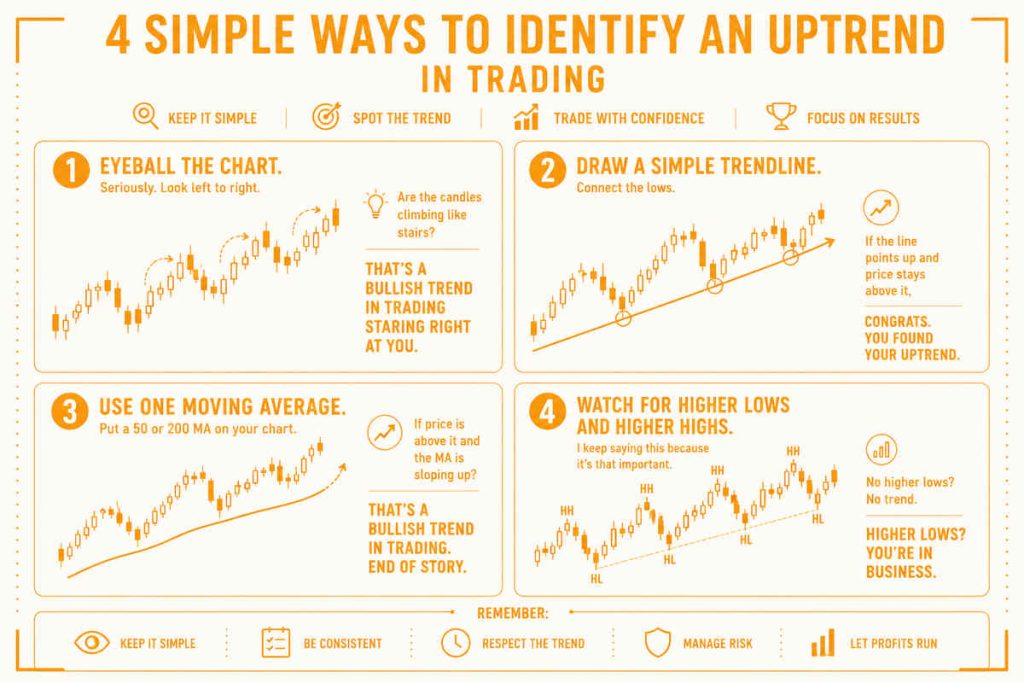
1. Eyeball the chart. Seriously. Look left to right. Are the candles climbing like stairs? That’s a bullish trend in trading staring right at you.
2. Draw a simple trendline. Connect the lows. If the line points up and price stays above it, congrats. You found your uptrend.
3. Use one moving average. Put a 50 or 200 MA on your chart. If price is above it and the MA is sloping up? That’s a bullish trend in trading. End of story.
4. Watch for higher lows and higher highs. I keep saying this because it’s that important. No higher lows? No trend. Higher lows? You’re in business.
So why do so many traders ignore all this?
Ego. They want to be the hero who calls the reversal. But here’s the truth. Heroes lose money. Smart traders ride the uptrend until it ends. No shame in that.
The trend is your friend. You’ve heard that a million times. But knowing it and doing it are two different things.
Now you know how to spot a bullish trend in trading. Next step? Actually trust it.
Conclusion
Look, here’s the bottom line. Whether you call it an uptrend or a bullish trend, the idea is the same: prices are moving higher. Up. North. In your favor. Mastering how to spot and trade these conditions gives you a clear edge in any market, on any timeframe, with any strategy.
Stop fighting the current. Stop trying to be the hero who picks the exact top. Start riding what’s right in front of you. The trend isn’t mysterious. It’s not hiding. It’s right there on the chart, waving at you with every higher low and higher high.
So next time you open your platform, ask yourself one question: is this a bullish trend or not? If yes, trade with it. If no, sit on your hands. That simple question will save you more money than any indicator ever will.
Now go find your trend. And don’t overthink it.
FAQ
1. What is the difference between an uptrend and a bullish trend in trading?
In most cases, they mean the same thing, a sustained price move upward. Some traders use “uptrend” to describe price action on a chart and “bullish trend” to describe overall market sentiment, but both point to the same direction: up.
2. How can I confirm a strong uptrend in trading?
You can confirm a strong uptrend using:
- Higher highs and higher lows on the chart
- Moving averages (e.g., price above 50 or 200 MA)
- Momentum indicators like RSI (above 50 but not overbought)
3. What is a bullish trend in trading for beginners?
A bullish trend means prices are generally rising over time. For beginners, it’s the best time to focus on buy (long) opportunities, as the market favors buyers over sellers.
4. Can an uptrend exist on smaller timeframes while the daily chart shows a downtrend?
Yes. A short-term uptrend in trading can occur inside a larger downtrend (countertrend move). This is often called a bullish pullback or retracement.
5. How long does a bullish trend usually last?
There’s no fixed duration. A bullish trend can last minutes (scalping), hours (day trading), weeks (swing trading), or even years (long-term investing). It depends entirely on the timeframe and market conditions.
6. What’s the most common mistake traders make during an uptrend?
Chasing price too late. Many traders see a strong uptrend and buy near the top, right before a pullback. The better approach: buy pullbacks within the trend, not breakouts after extended moves.
7. Is a bullish trend always good for every strategy?
No. While a bullish trend in trading benefits trend followers and breakout traders, it hurts short sellers and range-bound strategies. Always align your strategy with the current trend direction.


