
Have you ever stared at a price chart and seen nothing but a confusing mess of green and red blocks? Most beginner traders look at japanese candlesticks and have no idea what they are actually looking at. But once you understand how candlesticks work, that messy chart turns into a story about fear, greed, hesitation, and confidence. Every single candle tells you who won the battle between buyers and sellers, where price got rejected, and what might happen next.
The 300-Year-Old Secret
You might think candlestick charts were invented by some Wall Street genius in the 1990s. Nope. They were invented in 18th century Japan by a rice trader named Munehisa Homma. Yes, rice.
Homma realized something radical back then: price does not move just because of supply and demand. It moves because of emotion. Fear. Greed. Hope. Panic. He started tracking price on a chart, and over time, that chart turned into what we now call japanese candlesticks.
The crazy part? His method still works today. Whether you are trading Bitcoin, Apple stock, or the euro against the dollar, the same patterns show up again and again. Because humans haven’t changed. We still get greedy at the top. We still panic at the bottom. And candlestick charts catch all of it.
So when someone asks what are candlestick charts used for, the real answer is simple: reading the room. The trading room.
The Anatomy of a Candle
Every single candle tells you four simple things: the open, the high, the low, and the close. Traders call this OHLC. Think of it as the DNA of price.
The candlestick body is the fat part. It shows the distance between the open and the close. A long green body means buyers were in charge all period. A long red body means sellers crushed it. The candlestick wicks (also called shadows) are the thin lines above and below the body. They show where price got rejected. A long wick up? Buyers tried to push higher and failed. A long wick down? Sellers tried to push lower and got slapped back.
On a candle chart forex traders love, you can spot all of this in about two seconds. That is the beauty of it. No complicated math. Just a visual story of who is winning and who is losing.
The Hidden Psychology Inside Every Candle
Behind every single candle sits a battle. Buyers (bulls) want price up. Sellers (bears) want price down. The candle shows you exactly who won that battle and, more importantly, where they almost lost.
Take a long wick candle. A long lower wick tells you sellers pushed price down, but buyers jumped in and pushed it back up before the close. That is not random. That is rejection. The market is basically screaming: “We are not going lower. Not today.” A long upper wick tells the opposite story: buyers tried to run, but sellers said “nope” and slammed it back down.
This is where candle chart analysis becomes powerful. You stop seeing just green and red rectangles. You start seeing hesitation, exhaustion, and conviction. The candlestick explanation is simple: bodies show who controlled the period. Wicks show where they lost control. Once you see that, you can predict where price might go next.
And here is a secret most beginners never learn: a candlestick pattern psychology works the same in every market, forex, crypto, stocks, futures. Because fear and greed have no borders.
The Single Candlestick Patterns You Must Know

Single candle patterns are the easiest place to start. One candle. One story. No waiting for confirmation from a second or third candle. You just need to know what you are looking at and where it appears on the chart.
The Doji
A doji forms when the open and close are almost identical. The body is tiny or completely missing. This candle means indecision. Neither buyers nor sellers could take control. When you see a doji after a strong uptrend or downtrend, it often signals exhaustion. The market is taking a breath. A big move is coming soon. You just do not know which direction yet. So you wait.
The Hammer
A hammer has a small body at the top and a long lower wick at least twice the length of the body. It appears after a downtrend. The psychology is simple: sellers pushed price down hard. Then buyers stepped in and pushed it all the way back up before the close. The market rejected lower prices. This is a bullish reversal signal. The color of the body does not matter. A red hammer works the same as a green hammer.
The Shooting Star
A shooting star is the exact opposite. It has a small body at the bottom and a long upper wick. It appears after an uptrend. Buyers pushed price up to new highs. Then sellers took over and pushed it back down. The rally failed. This is a bearish reversal warning.
The Spinning Top
A spinning top has a small body centered between upper and lower wicks that are roughly equal in length. It means the market is balanced. Neither side won. This often appears during consolidation. It is not a trading signal by itself. It is a warning to wait for a breakout.
The Marubozu
A marubozu has no wicks at all. The body runs from open to high and open to low. A green marubozu means buyers controlled every single tick of the period. A red marubozu means sellers never let up. This is a strong continuation signal.
Double Candlestick Patterns That Flip the Trend
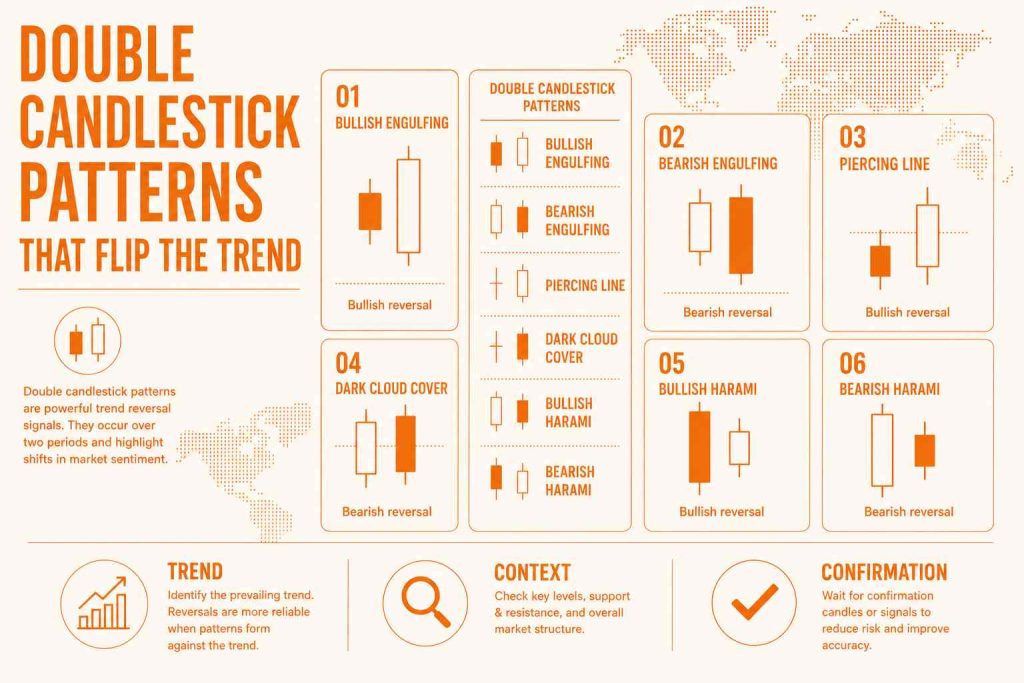
Single candles give you clues. Double candles give you confirmation. When two candles tell the same story, the probability of a real move goes way up.
The Bullish Engulfing
This pattern appears after a downtrend. First you see a small red candle. Then a larger green candle follows and completely swallows the red body. The psychology is powerful. Sellers were in control. Then buyers exploded onto the scene and erased everything the bears just did. Sentiment flipped in one period. This is one of the most reliable bullish reversal candlestick patterns in existence.
The Bearish Engulfing
Same idea but in reverse. After an uptrend, a small green candle is followed by a larger red candle that eats it whole. Buyers were happy. Then sellers destroyed them. The party is over. This is a classic bearish reversal candlestick pattern.
The Bullish Harami
Harami means “pregnant” in Japanese. After a downtrend, a large red candle is followed by a much smaller green candle that sits completely inside the previous red body. Selling pressure was strong. Then suddenly everything went quiet. The bears are exhausted. A reversal may be coming, but you should wait for a third candle to confirm.
The Bearish Harami
After an uptrend, a large green candle is followed by a tiny red candle inside it. Buyers ran out of gas. The trend is tired. Do not short yet. Wait for confirmation.
The Piercing Line
After a downtrend, a red candle is followed by a green candle that opens lower but closes above the midpoint of the previous red body. Sellers pushed even lower at open. Then buyers fought back hard and won by the close. This is a strong bullish signal.
The Dark Cloud Cover
After an uptrend, a green candle is followed by a red candle that opens higher but closes below the midpoint of the previous green body. Buyers pushed even higher at open. Then sellers crushed them. The reversal is real.
Triple Candlestick Patterns for High Probability Trades
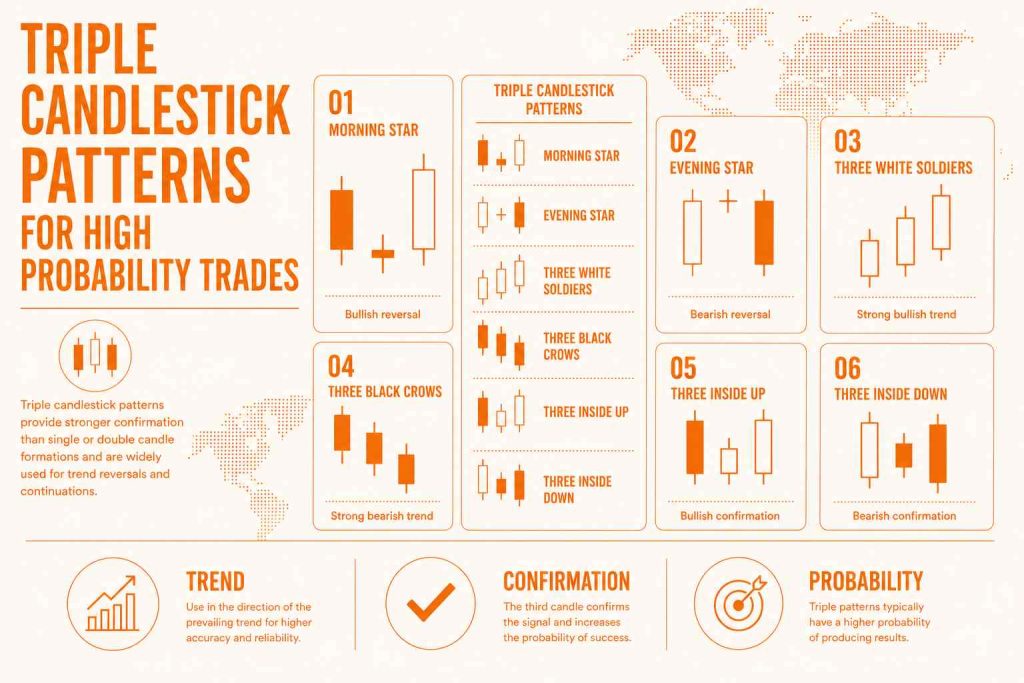
Three candles are better than two. When a pattern takes three periods to form, the signal is usually stronger and more reliable. These are the patterns professional traders wait for.
The Morning Star
This pattern appears after a downtrend. First you see a long red candle. Sellers are in full control. Then you see a small candle. It can be a doji, a spinning top, or just a tiny body. The market is pausing. Nobody knows what comes next. Then the third candle arrives: a long green candle that closes at least halfway into the first red body. Buyers have taken over. This is one of the most trusted triple candlestick patterns for catching a bottom.
The Evening Star
Same idea but for the top of an uptrend. First a long green candle. Buyers are confident. Then a small indecision candle. The market hesitates. Then a long red candle that closes deep into the first green body. Sellers have won. The top is in.
The Three White Soldiers
This is a beautiful pattern to watch. Three long green candles in a row. Each one opens inside the previous body and closes higher than the previous close. There are almost no wicks. Buyers are marching forward like soldiers. Nothing can stop them. This pattern works as either a reversal after a downtrend or a continuation of an existing uptrend.
The Three Black Crows
The opposite of soldiers. Three long red candles in a row. Each opens inside the previous body and closes lower. Sellers are in complete control. No buyers step up to fight back. This is a powerful bearish signal.
The Three Inside Up
This pattern takes four candles to complete but the signal comes from the last three. It starts with a bullish harami: a large red candle followed by a small green candle inside it. Then a third green candle closes above the first red candle’s open. Selling pressure, then exhaustion, then confirmation. The trend has flipped up.
The Three Inside Down
Same structure but bearish. A large green candle, then a small red candle inside it, then a third red candle that closes below the first green candle’s open. The bulls are done.
How to Trade Candlestick Patterns Like a Pro
Knowing the name of a pattern does not make you money. You need to know how to trade it. Where to enter. Where to place your stop loss. Where to take profits. Here is the simple framework.
Step One: Confirm the Pattern Location
A perfect bullish engulfing in the middle of nowhere is useless. You only trade patterns at support and resistance levels. Draw your horizontal lines. Look for round numbers like 1.2000 or 150.00. Use your moving averages. A hammer at a support level is a trade. A hammer floating in empty space is not.
Step Two: Check the Higher Timeframe
Never trade against the daily trend. If the daily chart is bearish, a bullish engulfing on the 15 minute chart is probably a trap. Use multi timeframe analysis to align your trade with the bigger picture. The higher timeframe gives you direction. The lower timeframe gives you entry timing.
Step Three: Enter With Confirmation
Do not buy the moment the hammer closes. Wait for the next candle. If the next candle trades higher than the hammer’s close, you have confirmation. This filters out false signals. The only exception is the engulfing pattern. You can enter on the close of the engulfing candle because the signal is immediate.
Step Four: Set Your Stop Loss
Your stop goes below the pattern’s low. For a hammer or a bullish engulfing, place your stop a few pips below the lowest wick. If price breaks that level, the pattern has failed. Get out.
Step Five: Set Your Take Profit
A good rule is to target twice your risk. If you risk 50 pips, aim for 100 pips. But do not be greedy. The first profit target can be the previous resistance level. The second target can be the next round number. Take partial profits along the way.
Candlestick pattern entry and exit is not complicated. You just need rules and discipline.
Common Mistakes and False Signals That Kill Beginners
You will lose money trading candlestick patterns. That is not because the patterns do not work. It is because you will make the same mistakes everyone makes at the start. Here are the big ones so you can skip ahead.
- Trading every pattern you see. Not every hammer is a trade. Not every engulfing is a buy signal. Most patterns form in the middle of nowhere with no support or resistance nearby. Those are low probability candlestick signals. Skip them. Wait for patterns at real levels. Less trading. Better results.
- Ignoring the higher timeframe. You see a beautiful bullish engulfing on the 5 minute chart. You buy. Then price crashes. What happened? The daily chart was in a downtrend. You were trying to catch a tiny pullback against the ocean current. Candlestick pattern reliability drops dramatically when you trade against the higher timeframe trend.
- No confirmation candle. A hammer forms. You buy immediately. Then the next candle turns red and crashes through the hammer’s low. You lose. The problem is not the hammer. The problem is you did not wait for confirmation. The next candle tells you if the pattern is real or fake. Be patient.
- Ignoring market sessions. A hammer during the Asian session when volume is thin is not the same as a hammer during the London open. Thin markets produce fake patterns. False candlestick signals happen all the time when liquidity is low. Trade only during London and New York sessions for higher quality setups.
- Placing the stop loss too tight. You put your stop 10 pips below the hammer. Price wicks down 15 pips, hits your stop, then rallies 200 pips without you. That is called getting wicked out. Give the pattern room to breathe. Put your stop below the wick, not inside it.
Conclusion
Japanese candlesticks are not magic. They do not predict the future. But they do something just as valuable. They show you what happened, who was in control, and where the market changed its mind.
You now know what candlestick charts are and where they came from. You know how to read the body, the wicks, and the story inside every candle. You have seen the most important single, double, and triple candle patterns. And you understand that patterns alone are not enough. You need location, confirmation, and the right session.
The best traders do not memorize every pattern name. They learn to read the psychology behind the candles. A long wick means rejection. A small body means hesitation. Three green soldiers in a row means buyers are marching. That is the real candlestick trading explained in one sentence.
Start small. Focus on one or two patterns first. The hammer and the engulfing are great places to begin. Trade them only at key levels during London or New York. Wait for confirmation. Use a stop loss. Take partial profits. And do not get emotional.
The market is not random. Behind every candle, someone is feeling fear, greed, or patience. Your job is to read that story before the next candle begins.
FAQ
What is the most reliable candlestick pattern?
According to historical studies, the three white soldiers pattern has the highest success rate at around 82 to 84 percent. Bullish and bearish engulfing patterns are also highly reliable when they appear at key support or resistance levels.
What does a long wick tell you?
A long wick shows price rejection. A long upper wick means buyers tried to push up and failed. A long lower wick means sellers tried to push down and got rejected. The market is telling you it does not want to go there.
Is a red hammer still bullish?
Yes. The color does not matter. What matters is the shape and the location. A red hammer after a downtrend is just as bullish as a green hammer. Focus on the wick and the body, not the color.
What is the difference between a hammer and a hanging man?
Same shape. Different location. A hammer appears after a downtrend and signals a bullish reversal. A hanging man appears after an uptrend and warns of a bearish reversal. Location is everything.
Can you trade candlestick patterns on lower timeframes like 1 minute or 5 minutes?
Yes, but the reliability is much lower. Lower timeframes have more noise and more false signals. Most professionals prefer the 1 hour, 4 hour, and daily charts for pattern trading.
Do candlestick patterns work in all markets?
Yes. The psychology of fear and greed is the same whether you are trading forex, crypto, stocks, or commodities. Patterns work everywhere because human emotion works everywhere.
How do you avoid false signals?
Three rules. First, only trade patterns at support or resistance levels. Second, wait for confirmation from the next candle. Third, trade only during high liquidity sessions like London and New York.
What is the best pattern for beginners to learn first?
The hammer and the bullish engulfing are the most beginner friendly. They are easy to spot and have clear rules. Learn those two first. Add more patterns later.
Should you use candlestick patterns alone or with indicators?
Use them together. Patterns give you timing. Indicators like moving averages or RSI give you context. The combination is stronger than either one alone.
How long does it take to master candlestick trading?
You can learn the patterns in a few days. Mastering the location, the timing, and the discipline takes months or years. The best traders never stop learning.


