
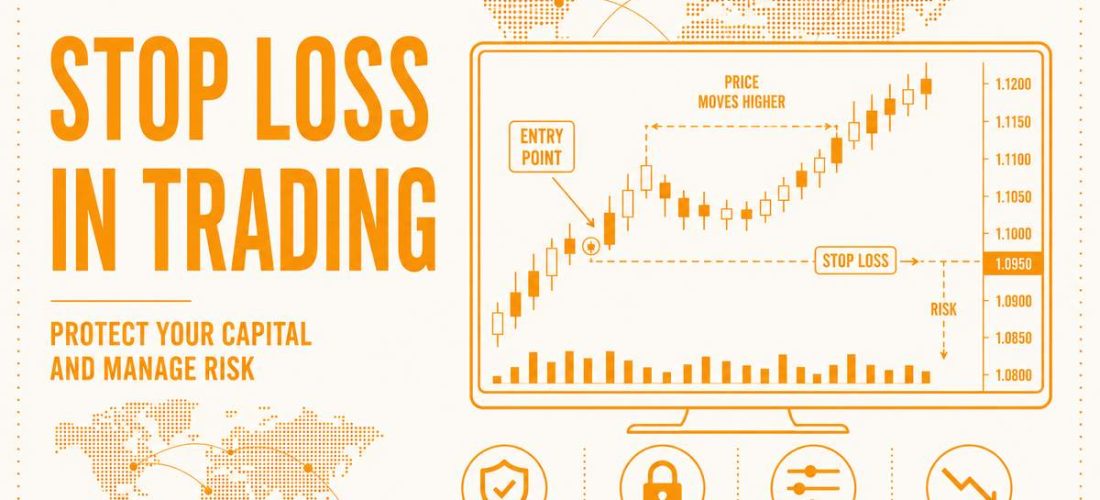
Stop Losses
Save Accounts
Widening a stop loss after entering usually turns a planned loss into a dangerous emotional trade.
Use swing highs, swing lows, support, resistance, or volatility instead of random distances.
Professional traders accept controlled losses daily because protecting capital matters more than winning every trade.
Let’s face it. Trading without a stop loss is like driving a car without brake pads. You might feel fine cruising down the highway, but the second traffic comes to a screeching halt, you are heading for a nasty crash. A stop loss isn’t just a fancy button on your trading platform. It’s your safety net, your seatbelt, and your “do not go broke” insurance all rolled into one. Whether you are day trading wild meme stocks, swing trading over a few weeks, or holding long term positions, knowing how to protect your capital can mean the difference between a small hiccup and blowing up your entire account.
In this guide, we will break down exactly how automatic risk controls work in plain English. You will learn where to plant your exits, how to calculate them without a headache, and what really happens when your exit gets triggered but nothing happens (yes, that can happen). We will also dig into advanced tricks, the ugly truth about market makers hunting liquidity, and whether your protective orders even work after the market closes. No fluff, no complicated theories. Just real world, actionable advice you can use today.
What Is a Stop Loss? Definition and Meaning
Let’s start with the basics. A stop loss is an order you place with your broker that automatically closes a trade when the price hits a specific level. Think of it as a “cut your losses” button that fires without you needing to stare at the screen.
Here is the stop loss meaning in plain English. You start with $100. But you don’t want to lose more than $5 per share if things go south.
So you set a stop loss at $95. If the price drops to $95, your position is automatically closed, your broker automatically sells your position. You are out with a small, manageable loss. No emotions, no hesitation, no hoping for a turnaround that never comes.
A stop loss works for both long and short trades. For a long trade (buying), you place the stop loss below your entry price. For a short trade (selling), you place it above your entry price. In both cases, the goal is the same: to cap your downside before things get ugly.
Why is this so important? Because traders are human. Humans freeze. Humans panic. Humans stare at a losing trade and think, “Maybe it will come back.” A stop loss removes that painful decision from your hands. It’s not about being right all the time. It’s about staying in the game long enough to be right when it really counts.
How to Set a Stop Loss: Step-by-Step Rules
Setting a stop loss sounds simple. Just pick a number, right? Wrong. Put it too tight, and a random wiggle will knock you out before the trade even starts. Put it too loose, and you are bleeding money on every loser. There is a sweet spot, and finding it takes a mix of logic, math, and a little bit of market psychology.
Let’s break down the most common methods. Pick the one that fits your trading style.
The Fixed Percentage Method
This is the go-to method for beginners. You simply decide what percentage of your account you are willing to risk on a single trade. Most professionals risk between 1% and 2% per trade.
That means if you have a $10,000 account, you should not lose more than $100 to $200 on any single trade. To calculate your stop loss level, you take your entry price and subtract your risk per share.
For example:
If you buy a stock at $50 and your stop loss is set at $49, then you are risking $1 per share. Simple, clean, and easy to calculate.
But here is the catch. The fixed percentage method ignores the market’s behavior. A 2% stop on a calm stock might be reasonable. On a wild crypto coin that moves 5% every hour, that same 2% stop will get hit constantly. That is why many traders move on to more dynamic methods.
Placing Stop Loss Below Swing Lows for Long Trades
This is where technical analysis comes in. Instead of picking a random percentage, you look at the chart and find recent support levels. The idea is simple. A stop loss below swing low gives the trade room to breathe. If price dips below that recent low, the market is telling you that your thesis is wrong.
Let’s say you buy a stock that just bounced off a low of $48 and then climbs to $52. A smart place for your stop loss would be just under that $48 swing low, maybe at $47.50. If the price drops and breaks through that level, you are out of the trade.
This method works because markets tend to respect previous support and resistance. Break below support? The party is over. Time to pack up and go home.
Moving Stop Loss to Break Even
Once a trade moves in your favor, you can lock in a risk free position. You simply move stop loss to break even. That means raising your stop from below entry to exactly your entry price plus fees.
Here is how it plays out. You buy at $50 with a stop at $48. The price climbs to $55. At that point, you move your stop up to $50.10, just above your entry, to cover commissions and small costs. If the price then crashes back down, you exit the trade at roughly breakevenб with zero real loss.
You’ve essentially turned the trade into a “free shot” at upside: risk is removed, but profit potential remains. Smart traders do this aggressively on fast moving trades. Dumb traders get greedy, refuse to move their stop, and watch a winning trade turn into a loser. Do not be the dumb trader.
How Tight Should Your Stop Loss Be?
This question keeps beginners up at night. How tight should stop loss be depends entirely on two things: the volatility of the asset and your time frame.
Scalpers who hold trades for two minutes need tight stops, sometimes 0.2% to 0.5%. Swing traders who hold for days or weeks need wider stops, often 3% to 8%, to survive normal back and forth movement.
A good rule of thumb is this. Your stop should be wide enough that normal market noise doesn’t trigger it, but tight enough that a real reversal gets you out quickly. If your stop gets hit on 80% of your trades, it is too tight. If you are losing 10% on every loser, it is too loose. Adjust until you find the balance.
Advanced Stop Loss Strategies
Basic stop loss methods work fine for beginners. But if you want to level up your trading game, you need tools that adapt to the market. Let’s talk about the good stuff.
ATR Stop Loss
ATR stands for Average True Range. It measures how much a price typically moves over a given period. Think of it as a volatility thermometer. The higher the ATR, the wilder the price swings.
An ATR stop loss uses this number to set your stop dynamically. Instead of guessing a percentage, you let volatility decide. The formula is simple. For a long trade, you subtract a multiple of the ATR from your entry price.
Here is an example. You buy a stock at $100. The 14-day ATR is $3, and you decide to use a 2x multiple. That means your stop distance is $6, so your stop goes at $94. If the stock is calm with a low ATR, your stop stays tight, but if the market becomes more volatile and the ATR rises, your stop automatically widens to match the increased noise. It adjusts to market conditions instead of forcing a fixed level, which helps you avoid getting stopped out by normal volatility while still controlling risk.
This method keeps you in trades during normal noise but cuts you loose when things truly break down.
Trailing Stop Loss
A trailing stop loss is like a loyal dog that follows you but never passes you. It moves up as the price moves up, but never moves down. This lets you capture huge trends while protecting profits along the way.
How does it work? You set a trailing stop, either as a fixed dollar value or a percentage. For example, you buy at $100 and set a trailing stop of $5, so the stop initially sits at $95. If the price rises to $110, your stop automatically moves up to $105. If it continues to $130, your stop follows to $125. Then, if the price suddenly drops, you are taken out at $125, locking in a $25 profit instead of giving it all back.
The tricky part is choosing the right distance. A best trailing stop loss percentage for most swing traders is between 5% and 10%. Too tight, and you get shaken out on a normal pullback. Too loose, and you give back too much profit. Test and adjust.
Best Stop Loss Strategy for Your Style
There is no single best stop loss strategy for everyone. It depends on how you trade.
If you scalp for tiny profits, use a very tight fixed percentage stop, maybe 0.2% to 0.5%. You cannot afford big losses. If you swing trade over days or weeks, use an ATR based stop or a swing low stop. Give yourself room to breathe. If you trend follow and want to catch home runs, use a trailing stop loss. Let your winners run but never let them turn into losers.
Pick one strategy. Stick with it for at least 20 trades. Then adjust. Do not bounce around every day or you will never know what actually works.
Common Problems and Failures of Stop Loss
Where Stops Fail
Stop Hunting
Price spikes through obvious levels to trigger clustered retail stops before reversing.
Gaps
Price skips your stop entirely on news or earnings, filling at a much worse level.
Slippage
Fast markets cause execution below your stop price due to lack of liquidity.
After Hours Risk
Stops may not trigger properly outside regular sessions or in pre-market trading.
Standard stops are not guaranteed fills — only “best available price.”
Small planned losses can become large during extreme market moves.
Guaranteed stops or position sizing are the real safety layer.
Stop losses are powerful tools, but they are not magic. Things go wrong. Sometimes the market eats your stop like it never existed. Other times your broker sleeps on the job. You need to know what can break so you can protect yourself.
Stop Loss Hunting
Have you ever set a stop loss perfectly, only to watch price tag your level by one cent, trigger your exit, and then rocket up without you? Congratulations. You just got hunted.
Stop loss hunting happens when big players, like institutions or market makers, push price just low enough or high enough to trigger a cluster of stop orders. They grab liquidity, fill their own big orders, and then let price resume its original direction. Retail traders like you get thrown out right before the big move.
How do you fight back? Stop placing your stops on obvious round numbers like $50.00 or $49.95 because that’s exactly where most traders cluster their orders. Instead, try to place your stop slightly beyond the obvious level to avoid getting caught in short-term volatility or “stop hunts.” For example, if many stops are sitting around $49.95, you might place yours at $49.82 instead. This small adjustment can help you survive those quick spikes that temporarily push price through obvious levels before reversing, improving your chances of staying in valid trades longer.
Stop Loss Gaps
This one hurts. A stop loss gap happens when price jumps over your stop level without trading there at all. This usually occurs overnight or over weekends when the market is closed.
Imagine you hold a stock that closes at $50 and you set your stop at $48. Overnight, the company reports terrible earnings, and the stock opens the next morning at $42. Your stop loss never actually triggers at $48 because price never traded through that level, it simply gapped straight past it. Instead, you get filled at the next available price, which could be $42 or even worse depending on liquidity. That’s how a small planned 4% loss can suddenly turn into a 16% loss overnight.
This is the ugly truth. Standard stop losses do not guarantee your fill price. They guarantee an execution at the next available price. And that price can be very, very far away.
Do Stop Losses Work After Hours?
The short answer is no. Most brokers do not execute stop loss orders outside regular trading hours. Stop losses work after hours only if you specifically use an extended hours trading session with your broker, and even then, liquidity is terrible.
Pre market is even worse. Do stop losses work pre market? Usually not. Price can crash 20% in pre market trading, and your stop will sit there like a sleeping guard dog. It only wakes up when the opening bell rings. By then, the damage is done.
If you trade volatile assets or hold over weekends, you need to understand this risk. The only real protection is a guaranteed stop loss, but that costs extra.
Stop Loss Triggered But Not Executed
You get the alert. Your stop loss was triggered. But when you check your position, you are still in the trade. How? Stop loss triggered but not executed happens during fast markets or low liquidity.
Your stop becomes a market order when triggered. But if there are no buyers at that moment, your order sits there unfilled. Price keeps moving against you while you wait. By the time you get filled, your loss is much bigger than planned.
Some brokers offer stop limit orders to control this, but that comes with its own risk. If price never returns to your limit, you never get out at all.
Guaranteed Stop Loss
A guaranteed stop loss is the closest thing to a safety guarantee. You pay a small fee or a wider spread, and in exchange, your broker promises to fill you exactly at your stop price, no matter what. No gaps, no slippage, no excuses.
The catch? Not all brokers offer them. They cost money. And they are not available on all markets or all hours.
Are stop losses guaranteed in general? Absolutely not. Only guaranteed stop losses are guaranteed. Everything else is best effort.
Why Use a Stop Loss? Pros, Cons and Psychology
By now you know how to set stop losses. You know the fancy methods like ATR and trailing. You even know the ways they can fail. But let’s step back and answer the bigger question. Why bother at all?
The Case for Stop Losses
Trading is not about being right. Trading is about being right enough times while keeping your losses small. A stop loss is the tool that keeps your losses small.
Think about it this way. Two traders both have a 50% win rate. Trader A lets losers run to 20% before cutting. Trader B cuts every loser at 5%. Trader A blows up after a few bad trades in a row. Trader B survives and lives to fight another day. That is the power of a stop loss.
Why stop loss is important goes beyond math. It removes emotion from the equation. When you enter a trade, you already know your exit price. You do not have to ask yourself, “Should I get out now?” The decision was made yesterday. You just follow the plan.
Are Stop Losses a Good Idea?
Yes, with exactly one exception. Are stop losses a good idea for most traders? Absolutely. For day traders, swing traders, and long term investors who want to protect capital, stop losses are essential.
The only exception is a tiny slice of professional strategies. Some hedge funds and institutional traders avoid hard stops because large players can see them and hunt them. They use mental stops or complex hedging instead. But if you are reading this guide, you are not that trader. Use your stops.
Should You Always Use a Stop Loss?
This question gets asked a lot. Should you always use a stop loss? The honest answer is yes, with a tiny asterisk.
For short term trading, always use a hard stop loss. No exceptions. Your future self will thank you.
For very long term investing in broad market ETFs, some people argue you do not need a stop. Markets always recover eventually, they say. Maybe. But ask anyone who bought at the peak of 2000 or 2008 how that worked out. It took over five years to break even. A stop loss could have gotten you out, preserved capital, and let you buy back cheaper.
So yes. Use a stop loss. Every single trade.
When Stop Losses Fail
We already covered technical failures like gaps and execution issues. But there is another kind of failure. Human failure.
You set a stop loss. Price drops toward it. You stare at the screen. You start making excuses. “This stock always bounces here.” “The news is good, so it will turn around.” “I will just give it five more minutes.” Price hits your stop. You do nothing. You cancel the stop in your mind. Then price drops another 20%.
A stop loss only works if you let it work. The second you override it, you are back to gambling. Discipline is not optional. It is the whole game.
The Bottom Line on Psychology
Trading is 10% strategy and 90% psychology. A stop loss is a psychological tool disguised as a technical tool. It gives you permission to be wrong. It lets you take the next trade without revenge or fear.
Without a stop loss, one bad trade can wreck your week, your month, or your account. With a stop loss, a bad trade is just a tiny scratch. You move on. You stay in the game. And staying in the game is how you eventually win.
Conclusion
A stop loss is not a sign of weakness. It is not for traders who lack confidence. In fact, the exact opposite is true. Professional traders use stop losses because they understand a simple truth. You cannot predict the market. You can only control how much you lose when you are wrong.
Throughout this guide, we covered the stop loss meaning from every angle. You learned how to set one, where to place it, and how to calculate the right distance for your trading style. You discovered advanced tools like the ATR method and trailing stops that adapt to market conditions. You also learned about the dark side. Stop loss hunting. Gaps. Failed executions. The hard truth that standard stops do not work after hours.
But none of that changes the bottom line. Trading without a stop loss is gambling. Trading with a stop loss is risk management. And risk management is the only thing that separates long term winners from blown up accounts.
Here is your action plan. Pick one stop loss method from this guide. Use it on your next ten trades. Do not change it. Do not override it. Just follow it. After ten trades, review your results. Adjust if needed. Then repeat.
The market will always be unpredictable. Your discipline does not have to be. Set your stop. Trust your stop. And live to trade another day.
Frequently Asked Questions
What is stop loss in trading?
A stop loss is an automatic order that closes your trade at a predetermined price to limit losses.
How does stop loss work?
You set a price level. If the market hits it, your broker automatically closes the position.
Where to set stop loss?
Common places include below a swing low, using a fixed percentage like 2%, or using ATR based distance.
How to calculate stop loss?
For percentage method: entry price minus risk percent. For ATR: entry price minus ATR multiplied by a factor like 2 or 3.
What is the best stop loss percentage for day trading?
Most day traders use between 0.5% and 1% per trade.
What is the best stop loss percentage for swing trading?
Swing traders typically use between 2% and 5% depending on volatility.
What is trailing stop loss?
A stop that moves up as price moves up but never moves down. It locks in profits while letting winners run.
What is the difference between stop loss and stop limit?
A stop loss becomes a market order. A stop limit becomes a limit order. The stop loss fills faster but may have slippage. The stop limit controls price but may not fill at all.
Do stop losses work after hours?
Generally no. Most brokers only execute stop loss orders during regular trading hours.
Do stop losses work pre market?
Usually not unless you specifically enable extended hours trading.
What is stop loss hunting?
When large players push price just past obvious stop levels to trigger retail stops, grab liquidity, then reverse price.
What is a stop loss gap?
When price jumps over your stop level without trading there, usually overnight or on news gaps.
What happens when stop loss is triggered but not executed?
You get a notification that your stop was hit, but no fill occurs due to low liquidity or fast market conditions.
What is guaranteed stop loss?
A paid feature where your broker guarantees execution at your exact stop price with no slippage or gaps.
Are stop losses guaranteed?
No. Only specifically labeled guaranteed stop losses are guaranteed. Standard stop losses can fail due to gaps and slippage.
Should you always use a stop loss?
Yes for short term trading. The only possible exception is very long term buy and hold strategies.
What is a buy stop loss?
A buy stop loss is placed above the current price. It is used for short trades to limit losses or for long entries on breakouts.


