
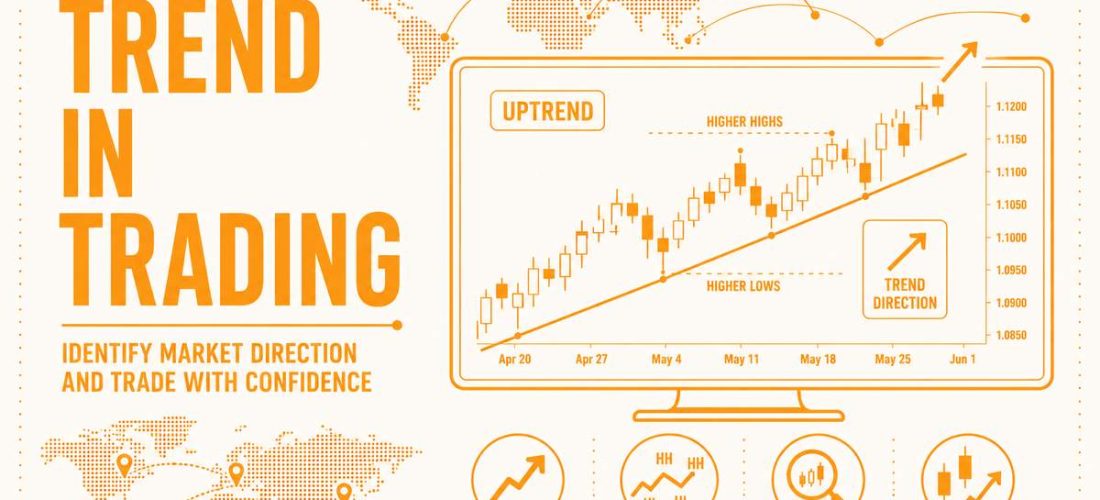
Trend in Trading
Learn how to read market direction using structure only: higher highs, higher lows, lower highs, lower lows, and clean support or resistance zones.
Let me cut straight to the chase. If you ignore the trend in trading, you are basically navigating a minefield blindfolded. Most newbies lose money not because they picked the wrong stock, but because they tried to fight the current. Think of it like rowing a boat upstream against a raging river. Sure, you might move forward for a second, but eventually you are going to get exhausted and flipped over. The trend is your map, your compass, and your current all rolled into one. Without it, you are just gambling.
In this guide, I am going to walk you through the nuts and bolts of what a trend actually is, strip away all the confusing indicators, and answer the million dollar question. Does trend trading really work, or is it just another pipe dream? We will keep it down to earth, no fluff, no jargon, just the raw truth about how to spot which way the wind is blowing and why catching a ride with it is the most profitable thing you can do as a beginner.
What Is a Trend?

So you want the answer to the what is a trend in trading question? Here it is plain and simple. A trend is the general direction of price movement over time. That is all. Price can do three things and three things only. It can go up. It can go down. Or it can go sideways.
Now, here is something most beginners do not realize. Trends do not exist because of some fancy algorithm or a mysterious market maker behind a curtain. They exist because of human psychology. Greed, fear, and herding behavior. When people see their neighbor getting rich, they jump in. When they see panic, they run for the exits. That herd mentality creates the trend.
And here is the kicker. Trends appear on every single timeframe you can imagine. One minute charts, hourly charts, daily charts, even monthly charts. The game is the same whether you are a scalper or a long term investor. A trend is a path of least resistance. Your job is to find it and follow it.
The Structure of an Uptrend
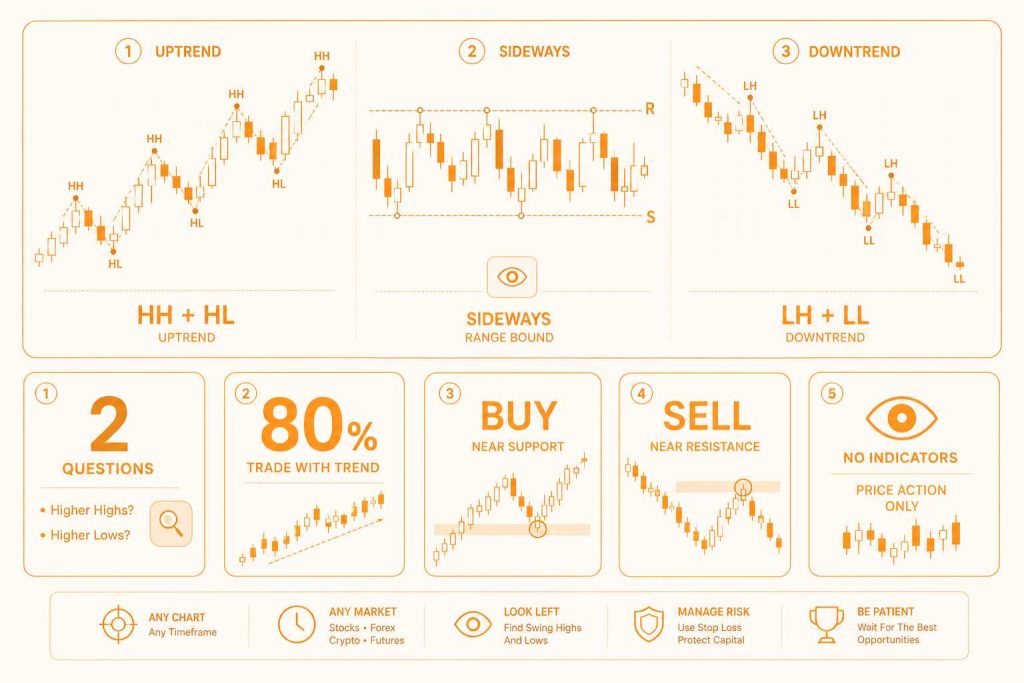
An uptrend has a very simple skeleton. It is made of higher highs and higher lows. Picture a set of stairs climbing up to the second floor. Each step is higher than the last. That is your uptrend. Buyers are in control here. They are willing to pay more and more over time.
Every time price dips, it does not go as low as the previous dip. Then it blasts through the old peak to set a new one. That is the signature of healthy buying pressure. As long as those higher lows keep showing up, the bulls are still running the show. The moment you see a lower low, that is your first red flag that the uptrend might be in trouble.
The Structure of a Downtrend
A downtrend is just the uptrend flipped upside down. It consists of lower highs and lower lows. Think of a roller coaster slowly sinking down the first big hill. Each bounce tries to go up, but it cannot reach the height of the bounce before. Then it rolls over and digs a new bottom that is even lower.
Sellers are in complete control here. Fear is driving the bus. Every time price tries to rally, people use that as their chance to get out, and they push prices right back down. As long as you are seeing lower highs, the bears have the upper hand.
The Sideways Trend (Ranging Market)
This one is the trap. A sideways trend has no clear direction. Price moves horizontally like a ping pong ball going back and forth between the same two lines. It bounces off a ceiling, falls down to a floor, then bounces back up again.
Here is the brutal truth. Trend trading does not work here. If you try to buy breakouts in a sideways market, you will get faked out every single time. If you try to sell breakdowns, price will snap right back in your face. Sideways is the graveyard for trend followers. You either sit on your hands and wait, or you switch to a different strategy like mean reversion. But do not force a trend trade where no trend exists.
Trend Meaning in Trading: Deeper Context
Let me give you the real trend meaning in trading. It goes way beyond just which way the line is sloping. The deeper trend meaning in trading is about consensus. When a trend is underway, the market is telling you that a majority of participants agree on value moving in that direction. That consensus becomes a self fulfilling prophecy.
Think about it. More and more traders jump on board because they see the trend. Their buying or selling adds fuel to the fire. The trend gets stronger. Then even more people jump in. It is a feedback loop. This trend meaning in trading as a filter is what separates winners from losers. You do not fight the trend. You do not guess reversals. You simply look at the larger timeframe trend, and you only trade in the direction it points.
Beginners who ignore this lose money. They try to pick tops and bottoms. They get run over by the freight train every single time. A trend is not your enemy. It is a current. Swim with it or get swept away. Your choice.
Trends in Different Markets
Trend in the Stock Market
Let me tell you something important. The trend in the stock market behaves differently than other markets. Individual stocks trend based on earnings, news, and sector rotation. A company reports blowout earnings? The stock trends up for weeks. A scandal hits? It trends down hard. But indices like the S&P 500 are a different beast. They reflect broader economic trends, not just one company’s drama.
Take the bull market trend from 2009 to 2021. It was one of the longest in history. Twelve years of higher highs and higher lows. People who understood the trend in the stock market rode that wave and made life changing money. Then came 2022. The bear market trend was sharp and painful. The same people who understood the trend got out of the way or even profited from the downside. Understanding the trend in the stock market helps you avoid two deadly mistakes. Buying during crashes and selling during rallies.
Trends in Forex vs Crypto vs Commodities
Not all trends are created equal. The market you trade changes everything.
Forex trends are longer and slower. They are driven by central banks, interest rates, and economic data. A trend in EUR/USD can last for months or even years. Patience is the name of the game here.
Crypto trends are the complete opposite. They are explosive and volatile. Bitcoin can rip 20% in a single day or crash just as fast. The trend in crypto can change on a dime based on a single tweet or regulatory headline. You make money fast, but you can lose it even faster.
Commodities like oil, gold, and corn trend in supply and demand cycles. A drought hits. Corn trends up. A recession hits. Oil trends down. The cycles are predictable once you learn to read them, but the swings can be brutal.
What Does Trend Mean in Trading Across Timeframes?
So what does trend mean in trading when you look at different timeframes? This is where beginners get tripped up. Let me break it down.
A long term trend lasts months to years. That is position trading. You are looking at weekly and monthly charts. A medium term trend lasts days to weeks. That is swing trading. Daily and four hour charts are your home. A short term trend lasts minutes to hours. That is day trading. You are glued to five minute and one hour charts.
Here is the key insight about what does trend mean in trading. You must align multiple timeframes. A five minute uptrend means absolutely nothing if the daily chart is in a downtrend. It is a trap. A countertrend bounce inside a larger fall. Beginners chase that five minute breakout and get crushed when the daily trend reasserts itself. Always know your higher timeframe trend before you even think about placing a trade.
Does Trend Trading Work?
Does Trend Trading Work? The Evidence
The question does trend trading work has been answered by decades of real world research and millions of trades. The answer is a clear yes. It works.
Let me give you the proof. Richard Dennis, a famous trader, bet that he could teach anyone to trend follow. He recruited a group of ordinary people with no trading experience. They became known as the Turtle Traders. Over four years, they made over $100 million. Then you have Ed Seykota, another legend who turned small accounts into fortunes using pure trend following methods. And there are countless hedge funds running systematic trend strategies that have survived for decades.
Academic studies back this up. Researchers have tested does trend trading work across stocks, forex, commodities, and even crypto. The data is clear. Markets are not random. Momentum exists. Prices tend to keep moving in the same direction once a trend gets going. So does trend trading work in practice? Yes. But here is the catch. Only with discipline. You cannot cherry pick trades. You cannot panic out of every pullback. You follow the system and take your lumps along with your wins.
When Trend Trading Fails
I am not going to sugarcoat it for you. Trend trading has a dark side. It fails hard in three specific conditions.
First is the ranging market. You already learned about sideways trends. No direction means no trend to follow. Buy breakouts and watch them reverse. Sell breakdowns and watch them bounce. It is death by a thousand cuts.
Second is high volatility chop. This is when price whipsaws back and forth without any real conviction. One minute it is up, the next minute it is down. Your stop losses get hit again and again. Death by a thousand cuts, same as ranging.
Third is sudden news driven reversals. A trend can be humming along perfectly, and then a Fed announcement or a jobs report or a tweet sends everything flying in the opposite direction. Trend followers get crushed on those days. The key is accepting these failures as part of the game. No strategy wins every time.
Does Trend Trading Still Work in Modern Markets?
Here is the question every beginner asks. With algorithms, high frequency trading, and hedge funds running the show, does trend trading still work today?
Yes, it still works. But the game has changed a little. Trends may be shorter than they used to be back in the Turtle Trader days. Algorithms jump on moves faster. They also take profits faster. A trend that lasted six months in 1990 might only last six weeks today.
That does not mean you cannot profit. It means you have to adapt. You might need to use tighter stops. You might need to take profits quicker. You might need to focus on shorter timeframes. The core principle remains solid. Follow the trend. The trend is your friend. But in modern markets, that friendship might not last as long as it used to.
Is Trend Trading Profitable?
Is Trend Trading Profitable? Real Numbers
Let me answer the is trend trading profitable question with real numbers, not hype. The honest answer depends entirely on your risk management.
Here is something that will surprise you. Typical trend following win rates are only 35% to 50%. That means you lose more than half of your trades. But trend traders still make money. How? Risk to reward. A good trend trader aims for 1 to 2 or 1 to 3. That means risking one dollar to make two or three dollars. Do the math. A 40% win rate with a 1 to 3 risk to reward ratio gives you positive expectancy. You lose six trades and lose one dollar each. That is six dollars down. You win four trades and make three dollars each. That is twelve dollars up. Net profit is six dollars.
So is trend trading profitable for a disciplined trader who follows the rules and manages risk? Yes, absolutely. But is trend trading profitable for a gambler who chases hot tips, moves stop losses, and lets losers run? No chance. The strategy works. The question is whether you can work the strategy.
Profitability by Timeframe
Not all timeframes are created equal when it comes to profitability. Here is the breakdown from my experience.
Swing trading trends is the sweet spot for retail traders. You hold trades for days to weeks. You are not glued to the screen. You catch meaningful moves without the noise of every tiny wiggle. Most profitable trend traders I know swing trade.
Day trading trends is much harder. You are fighting against algorithms, transaction costs, and your own emotions. The trends are shorter and choppier. You need near perfect execution. It can be done, but the odds are stacked against you.
Position trading trends has the lowest stress. You hold for months or years. You sleep like a baby. But the drawdowns are larger. You might watch a trade go 20% against you before it turns around. That takes serious stomach acid. The returns can be huge, but you need patience and capital to survive the dips.
Realistic Returns for Trend Traders
Let me give you a realistic picture. Do not believe the gurus who promise to turn a thousand dollars into a million in six months. That is fantasy.
Skilled trend traders can make 20% to 30% per year on average. Some years are better. Strong trend years like 2020 or 2023 can see much higher returns, sometimes 50% or more. Some years are worse. Choppy years might leave you flat or down a little.
Why Most Traders Fail at Trend Trading
So if trend trading works and it is profitable, why do most traders blow up? I will tell you why. Three things. No patience. No discipline. No risk management.
They see a stock ripping higher and jump in late, right at the top. The trend pulls back, which is normal, and they panic sell at the bottom. Then the trend resumes without them. Or even worse, they trade against the trend. They see a market falling and think it is cheap. They try to catch the bottom. They get run over by the freight train again and again.
Beginners fail because they cannot sit on their hands during sideways markets. They must be in a trade every single minute. So they force trades where no trend exists. They lose money. Then they blame the strategy instead of their own impatience.
Trend trading is simple. But simple does not mean easy. Your worst enemy is not the market. It is the person staring back at you in the mirror.
Practical Application
How to Identify a Trend Without Indicators
You do not need a single indicator to spot a trend. No moving averages. No MACD. No RSI. Nothing but your two eyes and a chart.
Here is what you do. Look left on the chart. Find the swing highs, the peaks where price turned down. Find the swing lows, the troughs where price turned up. That is it.
Now ask yourself two questions. Are the swing highs getting higher? Are the swing lows getting higher? If the answer to both is yes, you are in an uptrend. Plain and simple.
Are the swing highs getting lower? Are the swing lows getting lower? If yes to both, you are in a downtrend.
If price is bouncing between the same high and the same low, you are in a sideways trend. Walk away. No trade.
This method works on any chart, any timeframe, any market. Stocks, forex, crypto, futures. A five minute chart or a monthly chart. Higher highs and higher lows. That is a trend. Once you train your eye to see it, you will never need another tool to tell you which way the wind is blowing.
How to Trade with the Trend
Identifying the trend is one thing. Trading it is another. Let me give you a simple playbook that actually works.
In an uptrend, you only want to buy. But you never buy at the highs. That is how you get stopped out five minutes later. You wait for a pullback. Every healthy uptrend takes breathers. Price dips, shakes out the weak hands, then continues higher. Your job is to buy near support on those pullbacks. Support can be a previous swing low, a moving average if you use one, or just a round number like 100 bucks.
In a downtrend, you only want to sell short. But again, you never sell at the lows. You wait for a rally. Price bounces up, sucks in the bottom pickers, then rolls over and continues lower. You sell near resistance on those rallies.
Here is the hardest part for beginners. You must be patient. You will watch an uptrend rip higher without you while you wait for a pullback. That is fine. There will always be another trade. Chasing is how accounts get blown up. Wait for your spot. Pull the trigger. Set your stop loss below the recent low in an uptrend or above the recent high in a downtrend. Then let the trend do its job.
Common Mistakes
Let me save you months of pain by naming the three mistakes almost every beginner makes. Avoid these and you are already ahead of 90% of traders.
- The first mistake is trading against the trend. You see a stock that has doubled and think it is too high. Surely it must come down. So you short it. Then it doubles again. Or you see a stock that has been crushed and think it is cheap. So you buy the dip. Then it gets cut in half again. The market does not care about your opinion. The trend is the truth. Do not fight it.
- The second mistake is confusing a pullback with a reversal. In an uptrend, price will pull back. That is normal. It is healthy. But beginners see that pullback and panic. They think the trend is over. They sell their position. Then the trend resumes and they are left on the sidelines. How do you tell the difference? A pullback holds above the last swing low. A reversal takes out that low. Let price show you. Do not guess.
- The third mistake is using too many indicators. A beginner stacks up RSI, MACD, stochastic, Bollinger Bands, and three moving averages. The indicators contradict each other. One says buy, one says sell, one says do nothing. Paralysis by analysis. Strip it all away. Price alone tells you the trend. Higher highs and higher lows. That is all you need. Everything else is just noise dressed up in fancy colors.
CONCLUSION
Let me bring this full circle. The trend in trading is not some dark mystery reserved for Wall Street elite. It is simply price moving in one direction over time. Up, down, or sideways. That is it. Three options. Nothing more.
Understanding the trend in trading gives you a structural advantage over every trader who ignores it. They are gambling. You are trading with the current instead of against it. That is the difference between surviving and thriving in this game.
So let me answer the two questions you came here with. Yes, trend trading works. Decades of research and millions of real trades prove it. And yes, trend trading is profitable. But here is the kicker. Only if you bring three things to the table. Discipline to follow the rules. Patience to wait for your spots. And risk management to live and fight another day when you are wrong.
You do not need complex indicators. You do not need a dozen screens. You do not need a fancy algorithm. Price structure is enough. Higher highs and higher lows. Lower highs and lower lows. That is your compass. That is your edge.
Master the trend. Trade with it, not against it. Stop trying to pick tops and bottoms like a hero. Become the boring trader who catches the middle of the move and sleeps well at night. Do that, and you will be ahead of most traders before you even place your next trade.
The path is simple. The path is proven. Now go walk it.
FAQ
What is a trend in trading in one sentence?
A trend is the general direction in which price is moving. Up, down, or sideways.
What does trend mean in trading for a beginner?
It means you should only trade in the direction of the larger trend. Fight it and you will lose. Simple as that.
Is trend trading profitable for small accounts?
Yes, but risk management is even more critical when your account is small. One bad trade can wipe you out. Protect your capital first.
Does trend trading work in crypto?
Yes, absolutely. Crypto trends are very strong. The moves are explosive. Just be ready for brutal volatility along the way.
Can I trend trade on a 1 minute chart?
Possible but much harder. The noise will eat you alive. Most successful trend traders use higher timeframes like one hour, four hour, or daily.
How do I know when a trend ends?
Watch the structure. In an uptrend, the trend ends when you get a lower low and then a lower high. That breaks the pattern. Get out.
Do I need an indicator to follow a trend?
No. Many professional traders use nothing but price action and trend lines. Indicators just slow you down.


